$ALEIAH Ripped 746% in One Hour, but the Real Test Is the Holder Map
$ALEIAH has the ingredients degens want in an early Solana runner: live acceleration, usable liquidity for its size, disabled authorities, and a top-holder profile that is not instantly broken.
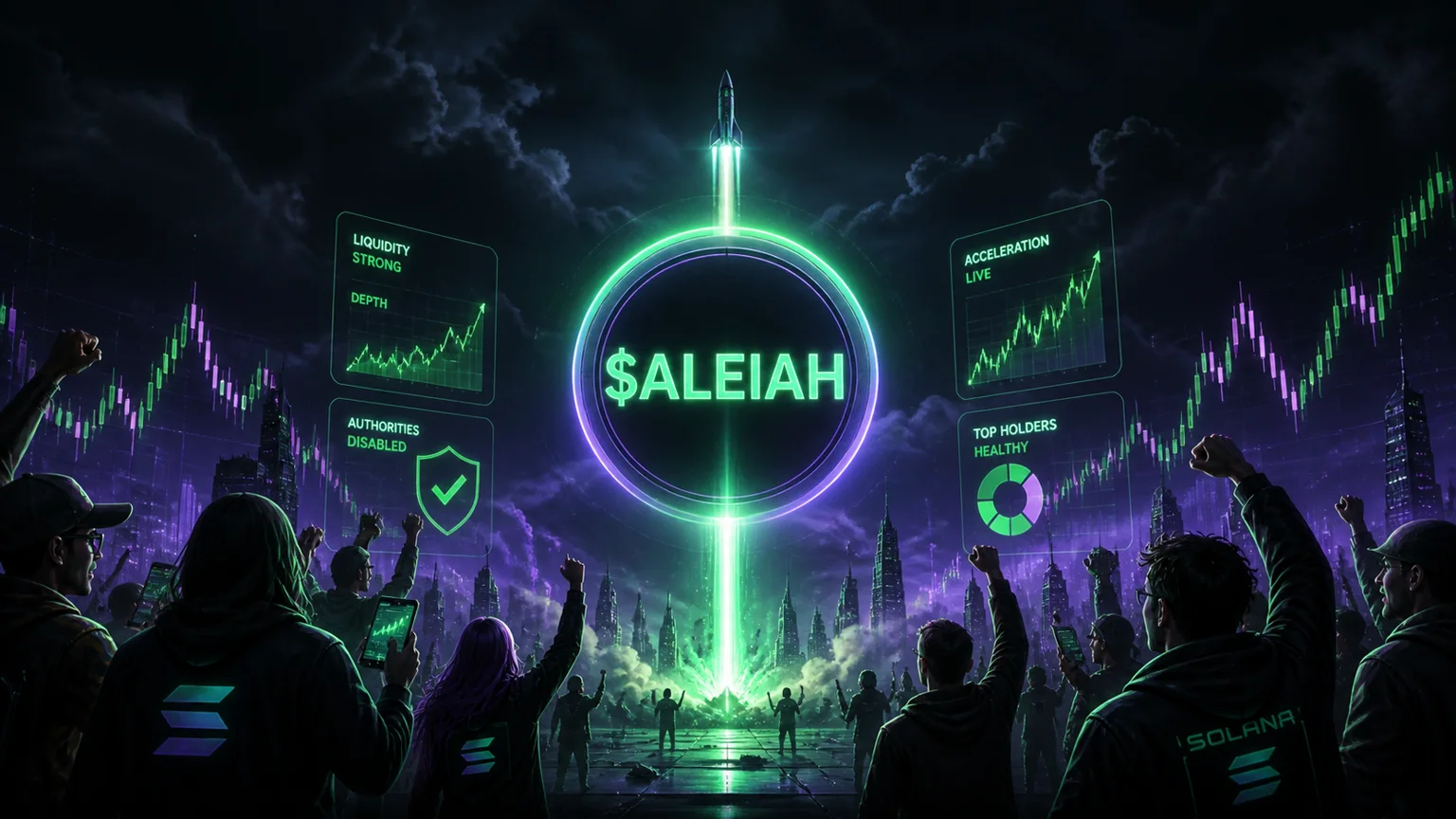
Top three holders control about 21.7% of supply, with mint and freeze authority disabled.
$ALEIAH is not big enough to pretend it is established. That is the first thing to get clear. At the latest read, Aleiah was still around an $80.6K market cap with about $12.2K in liquidity. But the chart did something worth writing down: it ripped roughly 746% in one hour, pushed more than $390K in 24-hour volume, and did it with a first on-chain profile that looks cleaner than the usual disposable pump.fun sprint.
- → $ALEIAH moved about 746% in one hour and roughly 1,000% over 24 hours while still sitting near an $80.6K market cap.
- → The token had around $12.2K in liquidity against $390K in 24-hour volume, which makes the move real enough to track and thin enough to punish late exits.
- → Rugcheck data shows a score of 1, disabled mint authority, disabled freeze authority, and top-three holder concentration near 21.7%.
The Move Is Small-Cap Violence
The one-hour percentage is the loud part, but the useful part is how $ALEIAH traded around it. A $390K volume print is not massive in absolute market terms, but it is large when the token's market cap is barely above $80K. That means the coin turned over multiple times against its own size while still operating inside a tiny Solana liquidity environment. In plain terms: traders found it, traded it hard, and kept the order flow alive long enough for the move to register as more than a single candle.
The one-hour buy ratio was about 57%, with 2,915 buys and 2,174 sells in that window. That is a cleaner shape than a pure sell-side unwind, but it is not the kind of imbalance that lets anyone relax. A move like $ALEIAH can look controlled until the first concentrated holder decides the crowd has arrived. The early read is positive because demand is active, not because the market has matured.
The Holder Test
$ALEIAH's best argument is not that it is huge. It is that, for a fresh microcap, the holder map is not immediately absurd. The available data shows 721 holders, top-holder concentration around 20.6% in the market feed, and a Rugcheck top-three figure near 21.7%. The largest listed holder sits at 15.69%, followed by wallets at 3.13% and 2.92%. That is still a lot of supply near the top. It is just not the catastrophic 50% to 70% cluster that often turns a new meme into a waiting room for one wallet.
This is why $ALEIAH fits a clean runner angle rather than a full green-light fantasy. The supply is concentrated enough to monitor, but not concentrated enough to dominate the entire story. If the top wallet distributes slowly while new holders arrive, the chart can keep breathing. If that wallet sells into the first serious bid, the move becomes another microcap lesson. The data leaves both outcomes open.
What the On-Chain Data Shows
The contract-side read is the reason $ALEIAH does not get filed as a simple chase warning. The Rugcheck profile lists freeze authority as false and mint authority as false. That matters because a live freeze authority can turn a tradable meme into a hostage situation, while a live mint authority can create supply risk that chart traders do not see until it is too late. $ALEIAH does not show those authority risks in the current profile.
The same profile shows a normalized rug score of 1 and no listed risk items. No insider flag appears on the three largest holder entries provided, and the creator token count is zero. Again, this is not proof of permanence or good intent. It is a cleaner-than-average first read. In early Solana trading, that distinction matters. The contract can look acceptable while the market itself remains brutally unsafe.
$ALEIAH clears the basic authority check, but the liquidity is only about $12.2K. That makes holder behavior and pool depth more important than the headline percentage move.
Why the Volume Matters
A new meme does not need a celebrity post or a giant account to become tradable in the first session. Sometimes the story is simpler: the market starts passing the token around, the candle rewards early buyers, and the liquidity pool becomes a live scoreboard. $ALEIAH looks like that kind of move. There are no confirmed notable callers in the available candidate data, so the cleaner editorial read is that the token is being carried by trading attention rather than an obvious promotional stack.
That can be a strength if the community keeps forming after the first candle. It can also make the bid disappear quickly. Promotional pumps often have a visible source of pressure. Organic microcap moves are harder to read because the same wallets that create the early volume can leave without a narrative bridge. For $ALEIAH, the next useful signal is whether holders increase and liquidity improves while volume remains active enough to support price discovery.
Bear Case
The bear case starts with scale. $ALEIAH is tiny. At an $80.6K market cap, even a moderate sell can look dramatic. Liquidity near $12.2K means a chart can move fast in both directions, and the 15.69% top holder remains large enough to matter. The top-three holder number near 21.7% is acceptable for a first look, but it is not invisible. Any aggressive distribution from the largest wallet would change the read immediately.
There is also the age problem. The pair was roughly six and a half hours old in the enriched snapshot. That is enough time for early excitement, not enough time for a durable base. Without known all-time-high context, the market cannot cleanly separate price discovery from late-stage chase. $ALEIAH can keep working only if the next phase looks less like a vertical sprint and more like a market that can absorb both buyers and sellers.
$ALEIAH gets a clean launch-radar read because the authority setup is clean, Rugcheck score is low, insider flags are not showing in the top-holder snapshot, and the holder concentration is moderate for a fresh Solana meme. The trade is still highly speculative by nature. The liquidity is thin, the largest holder is meaningful, and the chart has already moved hard. The reason to track $ALEIAH is not blind confidence; it is that the first data pass shows a live microcap runner with fewer obvious contract-side problems than usual.
What is $ALEIAH?
$ALEIAH is a new Solana meme token launched through pump.fun and tracked around an $80.6K market cap in the latest snapshot.
Why did $ALEIAH make the watchlist?
$ALEIAH posted a 746% one-hour move with $390K in 24-hour volume, while its current on-chain authority profile showed no obvious mint or freeze risk.
What should traders watch next?
Liquidity growth, holder growth, and the largest holder's behavior. Those three signals will decide whether $ALEIAH is building a base or just finishing a chase candle.