$1.8M in Volume on an $81K Market Cap: Inside the Trump-Themed $TRUST Token That Already Crashed 59%
Official Liberty launched on Solana with a political narrative and explosive volume. Within hours, it surged 111% — then gave back more than half. Here's what the on-chain data says about what really happened.
Top holder controls 13.84% of supply
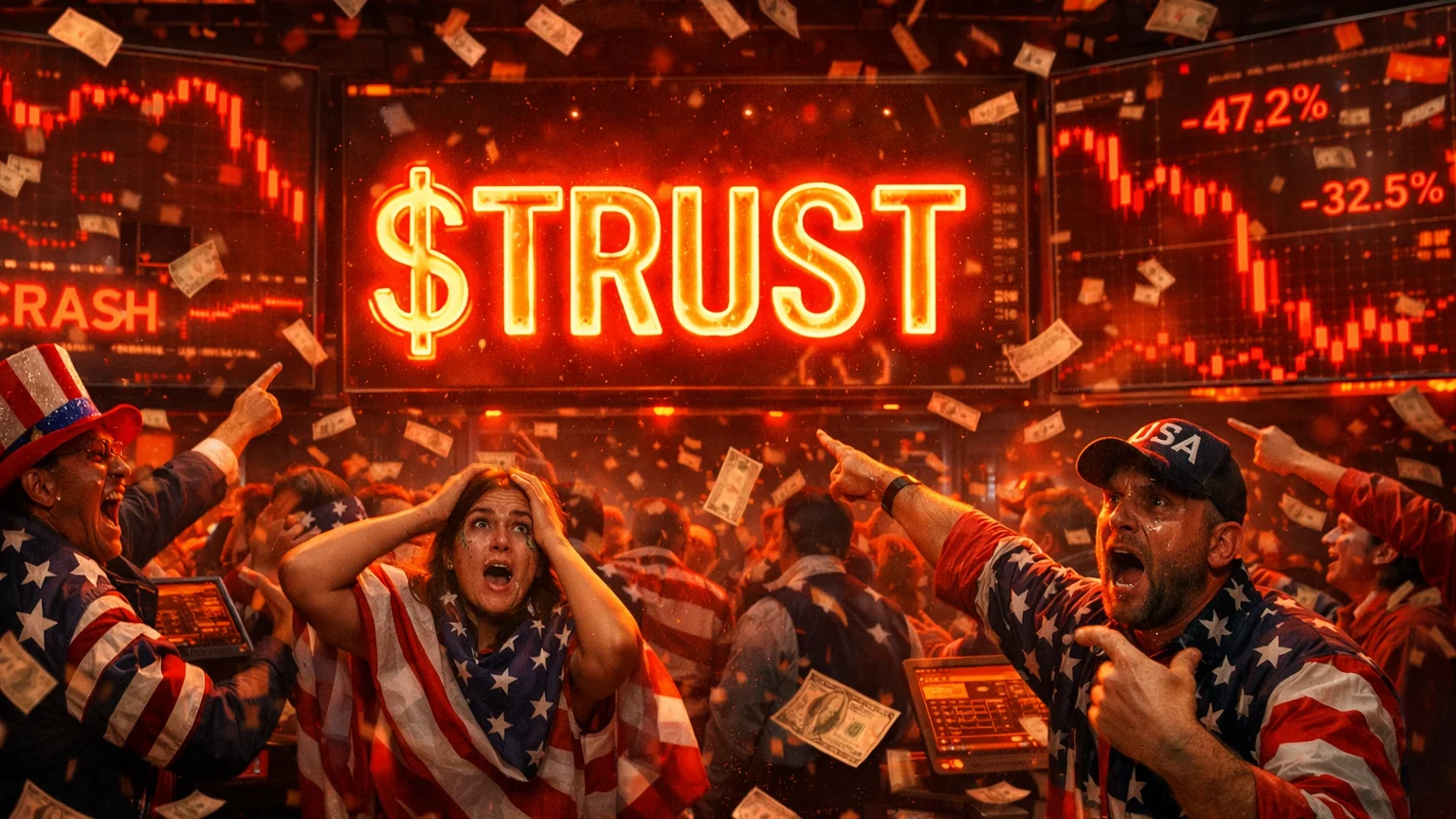
At some point on March 17, a new Solana token called Official Liberty — ticker $TRUST — appeared on DexScreener with a political narrative tied to Trump branding and a volume number that had no business being attached to an $81,000 market cap. Within its first 24 hours, $TRUST racked up $1.8 million in trading volume and a 111% price surge. By the time you're reading this, the token has already given back 59% of that pump in a single hour.
- → Trump-themed $TRUST launched on Solana via pump.fun with $1.8M in 24h volume against an $81K market cap — a 22:1 volume-to-mcap ratio that screams churn, not conviction
- → Price already crashed 59% in the last hour after the initial 111% surge, with liquidity sitting at just $25.7K
- → Top wallet holds 13.84% of supply — combined with razor-thin liquidity, any significant sell creates outsized price impact
What Makes This One Stand Out — and Not in a Good Way
Political meme tokens have a long and mostly tragic history on Solana. From the initial $TRUMP and $MELANIA launches that caught mainstream attention to the dozens of derivative plays that followed, the pattern is well-documented: launch with a polarizing political figure's name or likeness, ride the initial burst of ideological volume, and watch it evaporate when the narrative attention moves on. $TRUST — branding itself as "Official Liberty" — is the latest entrant in this crowded field.
The token launched via pump.fun, Solana's permissionless token launcher, which means there's no team vetting, no listing process, and no barrier to entry beyond paying the deployment fee. That's not inherently damning — plenty of legitimate community tokens start on pump.fun. But it does mean the "Official" in Official Liberty is pure marketing. There's nothing official about it.
The Numbers So Far
The volume-to-market-cap ratio here is the number that tells the real story. A 22:1 ratio means the token's entire market cap was traded 22 times over in a single day. For context, even the most actively traded large-cap meme coins rarely sustain a 5:1 ratio. A 22:1 ratio on an $81K token isn't organic accumulation — it's rapid-fire flipping. Traders cycling in and out, each one trying to scalp the next, creating the illusion of demand while the underlying holder base remains thin.
Then there's the liquidity. At $25,700, the pool is so shallow that a single $5K sell order would move the price by double digits. The 59% crash in the last hour wasn't a whale dumping — it was normal-sized exits creating cascading slippage in a pool that can't absorb them. This is the mechanical reality of micro-cap meme tokens: the entry feels easy, the exit is where the damage happens.
What the On-Chain Data Shows
The Rugcheck report paints a mixed picture. On the positive side: no freeze authority, no mint authority, and a rugScore of 16 out of 100 (lower is better). The deployer wallet holds zero tokens, having passed them all into circulation. No flagged risks in the automated scan. By the pure mechanical metrics, the token contract itself isn't set up to rug.
But the holder distribution tells a different story. The top wallet controls 13.84% of supply. The second holds 3.68%, and the third 2.62% — putting total top-3 concentration at 20.1%. None are flagged as insider wallets, but on a token with $25K in liquidity, that top holder's position represents real influence. If they decide to exit, there isn't enough depth in the pool to absorb it without catastrophic price impact. The remaining 80% of supply is distributed across what appears to be a thin holder base, given the token's age and market cap.
The Political Meme Playbook
Political meme tokens operate on a specific catalyst cycle. They spike on news events — election announcements, policy statements, viral moments — and they fade when the news cycle moves on. The original $TRUMP token demonstrated this at scale: explosive launch, mainstream media coverage, and then a slow bleed as the novelty factor decayed. Derivative plays like $TRUST don't even get the mainstream media catalyst. They're riding the coattails of a coattail.
The "trust" and "liberty" branding attempts to tap into a specific political identity, which is a proven emotional trigger for volume. But emotional triggers cut both ways — they drive impulsive buys AND impulsive sells. The 111% surge followed by a 59% crash within the same day is textbook emotional-trigger trading: people ape in on vibes, then panic when the chart reverses.
Who's In
No confirmed accounts with significant followings have publicly called $TRUST. The volume is being driven entirely by organic DexScreener discovery and Solana DEX traders scanning for fresh launches. In the political meme token space, the absence of amplification from prominent voices usually means the token is relying purely on ticker appeal and cultural timing — both of which have short half-lives.
The Bear Case
Almost everything about this setup screams caution. The market cap is micro, the liquidity is dangerously thin, the volume pattern suggests churn rather than accumulation, and the token has already retraced more than half its gains in sixty minutes. Political derivative tokens on Solana have a near-universal pattern of fast pump, fast dump, then a long slow bleed to irrelevance. The 20.1% top-3 wallet concentration against $25K liquidity creates an exit problem that simple math can't solve: there isn't enough buy-side depth to let large holders out without destroying the price.
The counter-argument is simple: political memes can catch fire unpredictably. A single viral tweet, a mainstream news mention, or a Trump-related event could send $TRUST on another leg up. But that's a lottery ticket thesis, not a trading thesis. And lottery tickets don't come with 59%-in-an-hour downside attached.
🔴 Shill Alert — $TRUST has all the hallmarks of a political pump trap: derivative branding, micro-cap liquidity, explosive volume from flippers rather than holders, and a price chart that already gave back most of its gains. The clean contract (no freeze/mint authority, low rug score) doesn't matter much when the economics are this fragile. The 22:1 volume-to-mcap ratio isn't demand — it's a revolving door. If you're already in profit, the exit is now. If you're watching from the sidelines, this is a spectator sport.
What is $TRUST (Official Liberty) crypto?
$TRUST is a Solana-based meme token launched via pump.fun with political branding tied to Trump and American liberty themes. It is not affiliated with any official political campaign or organization despite its name.
Why did $TRUST pump 111% and then crash?
The token attracted $1.8M in 24-hour volume against an $81K market cap, driven by political narrative appeal and DexScreener visibility. The crash followed as early buyers took profits into extremely thin liquidity ($25.7K), causing cascading price impact on exits.
Is $TRUST a rug pull?
The contract itself shows no rug mechanics — no freeze authority, no mint authority, and a low Rugcheck score of 16. However, the token's micro-cap liquidity and concentrated top holder (13.84%) create significant dump risk even without a traditional rug pull mechanism.
Is $TRUST safe to buy?
With $25,700 in liquidity and a 59% crash already in progress, any position in $TRUST carries extreme risk. The volume-to-mcap ratio suggests speculative churn rather than genuine accumulation. This is a high-risk micro-cap meme token — size positions accordingly.