
A Japanese Manga Meme Coin Just Did 3,767% in 8 Hours — and Its Creator Has Rugged 50 Tokens Before
ケイジ (Rooster Fighter) launched on pump.fun, pulled $321K in volume, and hit a $126K market cap before most of CT noticed. The catch: the dev's wallet has a trail of 50 dead tokens behind it.
Serial launcher (50 tokens), rugcheck danger flag for creator rug history. RugScore 80/100.
At approximately 1:00 PM UTC on March 16, 2026, a token named ケイジ — the Japanese word for "cage" and a nod to the manga series Rooster Fighter — appeared on pump.fun. Eight hours later, it had ripped 3,767%, accumulated $321K in 24-hour volume, processed over 6,100 transactions, and gathered 441 holders. The chart looked like a vertical line drawn by someone who'd never heard of gravity.
- → ケイジ (Rooster Fighter) surged 3,767% in 8 hours on pump.fun with $321K in volume and 441 holders
- → The deployer wallet has launched 50 prior tokens — Rugcheck flags a danger-level history of rugged projects
- → Top wallet holds 11.96% of supply; top 3 wallets control 18.9% — relatively distributed for a micro-cap degen play
What Happened
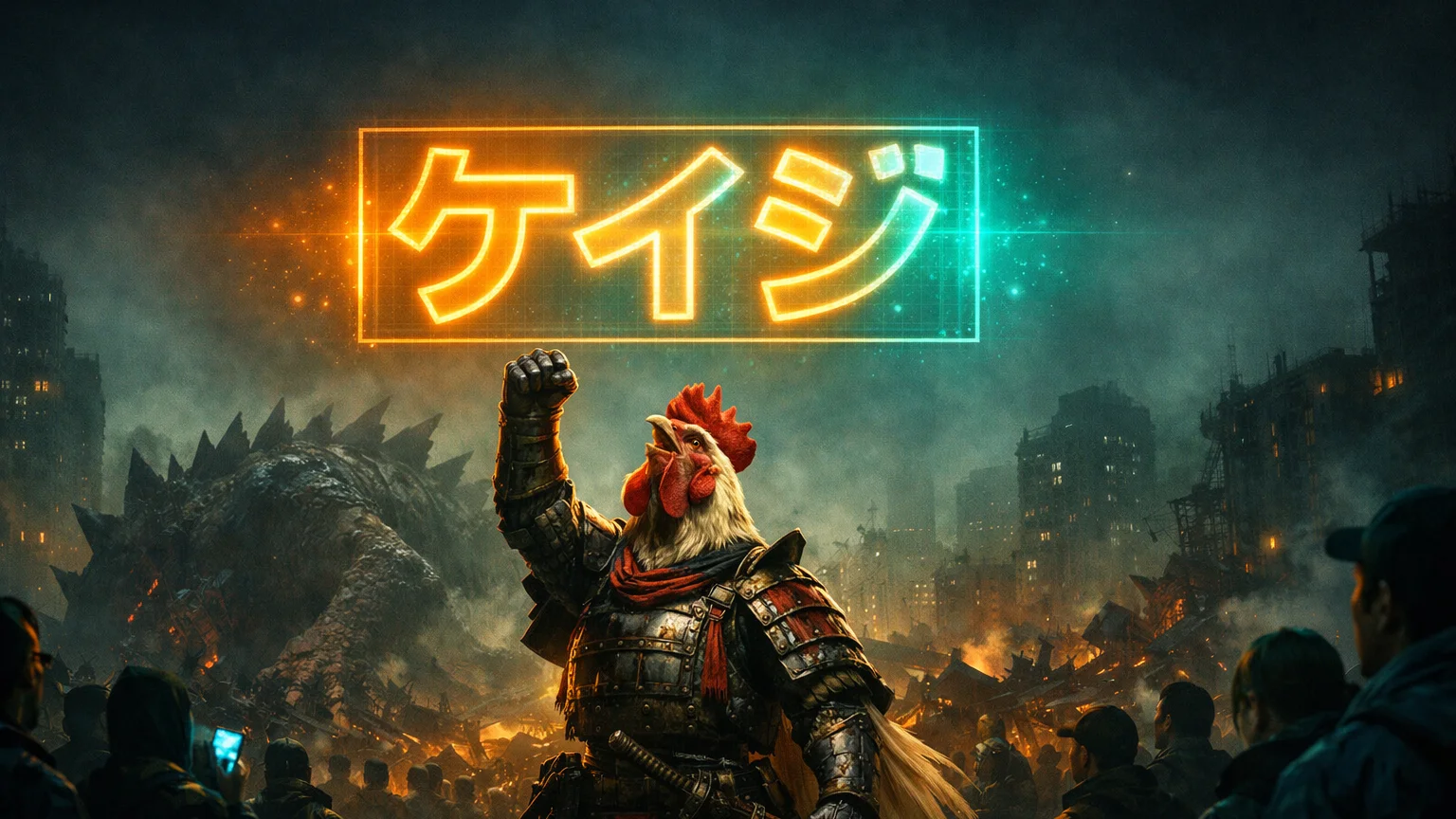
Rooster Fighter — or Niwatori Fighter, if you've actually read the manga by Sakuratani Shu — is an absurdist Japanese series about a rooster that fights kaiju to protect humanity. The manga ran in Shogakukan's Monthly Hero's magazine and earned a cult following for its deadpan premise: one rooster, one uppercut, one giant monster crumbling. It's the kind of IP that was always going to become a meme coin. The only question was when.
The when turned out to be today. Someone deployed ケイジ on pump.fun — Solana's bonding-curve launchpad — and it immediately caught bid. The 1-hour change hit +303% before the 24-hour number settled at the full 3,767% figure. Volume-to-market-cap ratio sits at roughly 2.5x, meaning the token is turning over more value than it's technically worth. That's either conviction or churn, and at 8 hours old, the distinction barely matters.
The Degen Translation
Manga-themed tokens have had sporadic runs on Solana before — usually tied to anime culture moments or viral panels crossing over into Western CT. ケイジ fits a micro-trend: tokens with Japanese characters in the name that force degen traders to paste kanji into their search bars, creating a natural filter between CT natives and normies. The thesis, if you can call it that, is that cultural novelty plus meme absurdity equals velocity.
The Rooster Fighter IP has built-in virality. A rooster punching kaiju is inherently shareable. The manga panels are meme-ready. And the character — a stoic barnyard bird saving humanity through sheer violence — maps perfectly onto the degen identity: small, underestimated, punching way above its weight class. The narrative practically writes itself, which is exactly what pump.fun deployers are counting on.
The Numbers
Let's be real about what we're looking at. A $126K market cap with $15.2K in liquidity means the exit door is roughly the width of a drinking straw. Over 6,100 transactions across 441 holders in 8 hours tells you the churn is aggressive — people are flipping, not holding. The 1-hour change of +303% at the time of signal detection suggests the pump was still accelerating when Jupiter's cooking feed picked it up.
The volume-to-liquidity ratio is concerning at ~21x. That much volume running through that little liquidity means price impact on any meaningful sell is going to be catastrophic. This is a one-way-door trade for anyone buying more than a few hundred dollars: you can get in, but getting out at these prices requires someone else to be even more degenerate than you.
What the On-Chain Data Shows
Here's where it gets interesting — and by interesting, we mean the kind of interesting that usually ends with a post-mortem. The top wallet holds 11.96% of supply. Top 3 wallets combine for 18.9%. For a pump.fun micro-cap, that distribution is actually moderate. No single wallet is sitting on a supply bomb that could vaporize the chart in one transaction.
But the deployer wallet tells a different story. Rugcheck flags a danger-level risk: "Creator has a history of rugging tokens." The wallet behind ケイジ has launched 50 prior tokens. Fifty. That's not a developer — that's a token factory. The rug score sits at 80 out of 100, which on Rugcheck's scale means "proceed with the understanding that you might be the exit liquidity."
No freeze authority. No mint authority. Those are the two existential kill-switches for Solana tokens, and neither is active here. That doesn't make this safe — nothing at $126K market cap with a serial deployer behind it is safe — but it means the rug, if it comes, will be economic (dev selling a position or pulling liquidity) rather than technical (freezing transfers or minting infinite supply).
Is This Sustainable?
Almost certainly not, and that's not even a controversial take. A 3,767% pump in 8 hours on $15K of liquidity from a wallet that has launched 50 previous tokens is, by every measurable standard, a lottery ticket. The question isn't whether this retraces — it's whether there's another leg up before it does.
The bull case is simple: the Rooster Fighter IP has genuine cultural recognition, the meme potential is untapped, and if a single mid-tier CT account picks this up and threads it, the 441 holders could become 4,000. Manga crossover tokens have hit seven figures before. The bear case is simpler: 50 rugged tokens. The deployer's track record is a graveyard, and ケイジ could be token number 51.
What tips the scale is the liquidity depth. $15.2K means the entire market cap can be drained by a few coordinated sells. At this level, you're not trading a token — you're trading against everyone else who's also trying to time the top. The rooster might be fighting kaiju, but at this liquidity level, the real monster is the slippage.
The Play
If you're already in, you know the rules: take profit in stages, don't let a 37x turn into a 1x. If you're looking at this from the outside, the asymmetric bet argument has some merit — a few SOL at this market cap has a nonzero chance of a 10x if the manga narrative catches, and the downside is bounded by whatever you're willing to lose.
But the 50-token deployer history is the kind of data point that should be tattooed on the inside of your eyelids before you ape. This wallet has done this before. Many, many times. The deployer didn't accidentally stumble into a manga-themed pump — this is a playbook, and the endgame of that playbook has historically not been kind to late entrants.
🟡 Speculative — The Rooster Fighter IP is legitimately memeable and the holder distribution isn't terrible, but a serial deployer with 50 prior tokens and a Rugcheck danger flag makes this a known minefield. The 3,767% pump happened on $15K of liquidity, which means the exit door is narrow enough to be decorative. Play this with money you'd comfortably set on fire.
What is ケイジ (Rooster Fighter) crypto?
ケイジ is a Solana meme token launched on pump.fun, themed after the Japanese manga 'Rooster Fighter' (Niwatori Fighter) by Sakuratani Shu. The manga features a rooster that fights giant monsters. The token surged 3,767% within 8 hours of launch.
Is ケイジ a rug pull?
The deployer wallet has launched 50 prior tokens and carries a Rugcheck danger flag for a history of rugged projects. While no freeze or mint authority is enabled, the serial deployer pattern is a significant risk factor. The rug score is 80/100.
What is the ケイジ contract address?
The Solana contract address for ケイジ (Rooster Fighter) is 4d7hkcY3MGAmYRi1vYNaDwi9C5Sfvdi4FqWCiLhtpump. It launched on pump.fun and trades on Jupiter.
What is the Rooster Fighter manga?
Rooster Fighter (Niwatori Fighter) is a Japanese manga by Sakuratani Shu published in Shogakukan's Monthly Hero's magazine. It follows a rooster that protects humanity by fighting kaiju with physical combat. The absurdist premise has made it a cult favorite and now a meme token catalyst.
How much liquidity does ケイジ have?
As of launch day, ケイジ has approximately $15,200 in liquidity against a $126K market cap. This extremely low liquidity means significant price impact on any sell of meaningful size.