The Orange Whale Surges 4,047% in Under an Hour — Whale-Themed Token Turns Smart Money Paranoia Into a Trade
A Pump.fun token built on crypto's oldest obsession — following the whales — just did a 40x in 30 minutes. If the smart money narrative sticks, this is the meme that eats its own tail. If it doesn't, 7,430 traders just learned that chasing whale memes is its own kind of trap.
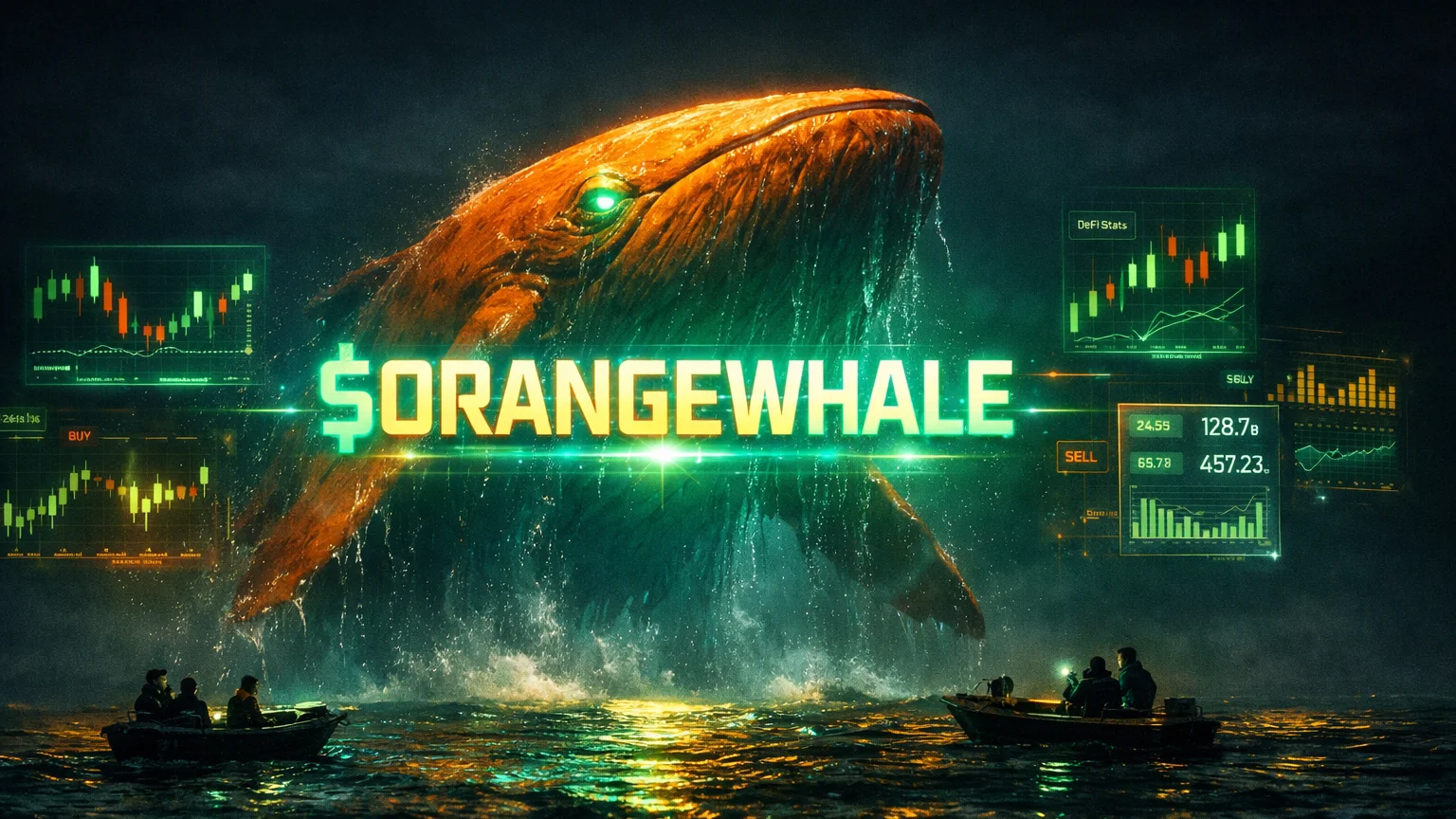
Somewhere around 3:45 PM UTC on March 30, 2026, a token called The Orange Whale ($ORANGEWHALE) appeared on Pump.fun and proceeded to do a 4,047% move in less than sixty minutes. That's not a typo — forty-times return in the time it takes to eat lunch. The token pulled $378K in volume across 7,430 transactions while building a $145K market cap from zero. It showed up on Jupiter's cooking feed, which is how most of DeFi Solana found it. The concept is deceptively meta: a whale-themed token launching during a period when Solana whale accumulation is one of the most-discussed narratives on CT.
- → $ORANGEWHALE pumped 4,047% in under an hour on Pump.fun — 40x from launch to peak
- → $378K volume across 7,430 transactions with $15.4K liquidity — extreme volume-to-liquidity ratio
- → Top 3 wallets hold 37.7% of supply with no freeze or mint authority — concentration is elevated
What Happened
The launch timing wasn't random. Crypto Twitter has spent the past week obsessing over whale wallet movements on Solana — large wallets rotating into SOL ecosystem tokens, accumulation patterns that suggest smart money is positioning for something. "Follow the whales" has become the default trading thesis for an entire subset of Solana degens. Into this environment drops a token literally called The Orange Whale, and the self-referential humor was immediately obvious to everyone watching.
The orange whale branding plays on multiple layers. There's the obvious Bitcoin orange (Saylor's "orange pill" brand of maximalism), the whale imagery that every crypto trader recognizes as shorthand for smart money, and the absurdist loop of buying a whale token while trying to follow actual whales. The token doesn't need a whitepaper or utility — the meme IS the utility. It's a commentary on the very behavior that drives meme coin markets: the desperate urge to be in the same trade as the biggest wallets.
The Degen Translation
Here's what CT actually heard when $ORANGEWHALE showed up on Jupiter's cooking feed: "There's a whale token pumping during a whale narrative." That's it. That's the entire thesis. In meme coin markets, meta-awareness IS the trade. When the market is talking about whales, you buy the whale token. When AI is trending, you buy the AI meme. When politicians tweet, you buy the political token. The pattern is so well-established that it's essentially a trading strategy — and $ORANGEWHALE's 4,047% move in under an hour is what happens when that strategy executes in real-time.
The Jupiter cooking feed acted as the primary distribution channel. When a token shows up on cooking — Jupiter's curated list of trending Pump.fun launches — it gets exposed to the entire Solana DeFi userbase simultaneously. That creates a demand shock that thin Pump.fun liquidity pools can't absorb gracefully, which is exactly how you get a 40x move in thirty minutes. The 7,430 transactions suggest broad participation rather than a few whales cycling volume, though at $15.4K liquidity, even small individual buys create significant price impact.
The Numbers
The volume-to-liquidity ratio here is staggering: $378K traded against $15.4K in liquidity means the pool has turned over roughly 24 times in under an hour. That's not trading — that's a centrifuge. Every dollar of liquidity has been recycled two dozen times, which tells you the price action is being driven by velocity rather than depth. This is typical of Pump.fun launches during their discovery phase, but the magnitude is notable even by those standards.
The buy ratio at 57% is telling — and it's significantly cooler than what you'd see during a one-directional pump. Compare this to Saylor Moon's 81.6% buy ratio during its early hours. A 57% ratio means for every 100 transactions, 43 are sells. The initial wave of buyers is already meeting resistance from early holders taking profit. This is the natural lifecycle of a Pump.fun token compressing into an absurdly short timeframe. A 4,047% move in under an hour doesn't leave room for a gradual cooldown — the selling pressure arrives while the buying pressure is still active.
Pair age of 0.5 hours at time of capture means this data represents the absolute peak of the initial mania. By the time you're reading this, the token has either found a second wave of buyers or the chart looks like a cliff. There's no middle ground at this velocity.
What the On-Chain Data Shows
Rugcheck assigns a risk score of 16/100 — clean by Pump.fun standards. No freeze authority, no mint authority. The mechanical rug vectors are absent, which means if this goes to zero, it'll be from natural selling pressure rather than a developer exploit. That's cold comfort when your 40x turns into a 4x, but it's the difference between getting outplayed and getting scammed.
The holder concentration is the main structural concern. Top three wallets control 37.7% of supply: the largest at 20.69%, second at 8.83%, third at 8.23%. That first wallet is doing a lot of heavy lifting — if that single holder exits, they're dumping over a fifth of the total supply into $15.4K of liquidity. The math isn't complicated: a full exit from that wallet would vaporize the price. No insider flags on any of the top holders, which suggests these are organic early buyers rather than coordinated snipers, but the concentration risk is real regardless of intent.
The deployer wallet has zero prior token launches — first-time creator. No history to analyze, no pattern to match. In isolation, that's neutral: most Pump.fun tokens are launched by first-timers. It only becomes a data point if the token survives long enough for the deployer's behavior to matter.
Is This Sustainable?
A 4,047% move in under an hour is definitionally unsustainable — nothing pumps 40x in thirty minutes and then trades sideways for a week. The question isn't whether the velocity sustains, it's whether the token itself survives the inevitable cooldown. And that depends entirely on whether the whale narrative has legs beyond today.
The bull case: Solana whale accumulation is a multi-week trend, not a one-day event. As long as CT is obsessing over whale wallets, $ORANGEWHALE has a built-in relevance loop. Every Lookonchain post about a whale buy, every Arkham alert about smart money moving — those become indirect catalysts for the token. The meta-meme doesn't need its own marketing because the broader market narrative does the marketing for it.
The bear case: $15.4K in liquidity is essentially nothing. The 57% buy ratio suggests selling pressure is already competing with buying pressure less than an hour in. The token has no website, no social channels, no community infrastructure — it's pure price action with a clever name. Once the Jupiter cooking feed moves on to the next token (which happens hourly), the attention funnel dries up. And 37.7% held by three wallets means the supply overhang is significant.
The most likely outcome: $ORANGEWHALE already printed its generational candle. The 40x move was the trade. Chasers who buy after the Jupiter cooking signal have a much worse risk/reward than the degens who caught it in the first five minutes. That's not a knock on the token — it's the structural reality of sub-hour Pump.fun launches with no liquidity. The edge was speed, and that edge is gone.
🟡 Speculative — The Orange Whale is a perfectly executed meta-meme: a whale token launching during a whale narrative, discovered via Jupiter's cooking feed at the exact moment when CT can't stop talking about smart money. Clean on-chain profile (16/100 rug score, no freeze/mint) but extreme concentration (37.7% in top 3) and paper-thin $15.4K liquidity make this a knife-catch for latecomers. The 40x already happened. If you weren't in the first five minutes, the risk/reward has shifted dramatically. Watch for a second wave if whale narrative headlines continue this week — but don't mistake a clever ticker for a sustainable position.
What is The Orange Whale ($ORANGEWHALE)?
The Orange Whale is a meme token on Solana launched via Pump.fun that plays on the 'follow the whales' narrative popular on Crypto Twitter. It surged 4,047% in under an hour after appearing on Jupiter's cooking feed on March 30, 2026.
Why did Orange Whale pump so much?
The token launched during a period of intense focus on Solana whale accumulation trends. The self-referential humor of a whale-themed token during a whale narrative, combined with exposure on Jupiter's cooking feed, created a demand shock against very thin liquidity ($15.4K), resulting in the 40x move.
Is Orange Whale a rug pull?
Rugcheck gives it a 16/100 risk score with no freeze or mint authority — the mechanical rug vectors are absent. However, the top wallet holds 20.69% of supply and liquidity is only $15.4K, so a large sell from any top holder could crash the price through natural market dynamics rather than an exploit.
What chain is Orange Whale on?
The Orange Whale ($ORANGEWHALE) is on Solana, launched via Pump.fun. The contract address is 7351qENjJ2bXbkJL33s6xKVSV1qYHDRztFywNJDpump.
Is it too late to buy Orange Whale?
The 4,047% pump happened in under an hour. The buy ratio has already dropped to 57%, indicating selling pressure is meeting buying pressure. With $15.4K liquidity, the entry risk for latecomers is significantly higher than for early buyers. The generational candle likely already printed.