A Baby Hippo Named Jellybean Just Became a $7M Solana Meme Coin — Because of Course It Did
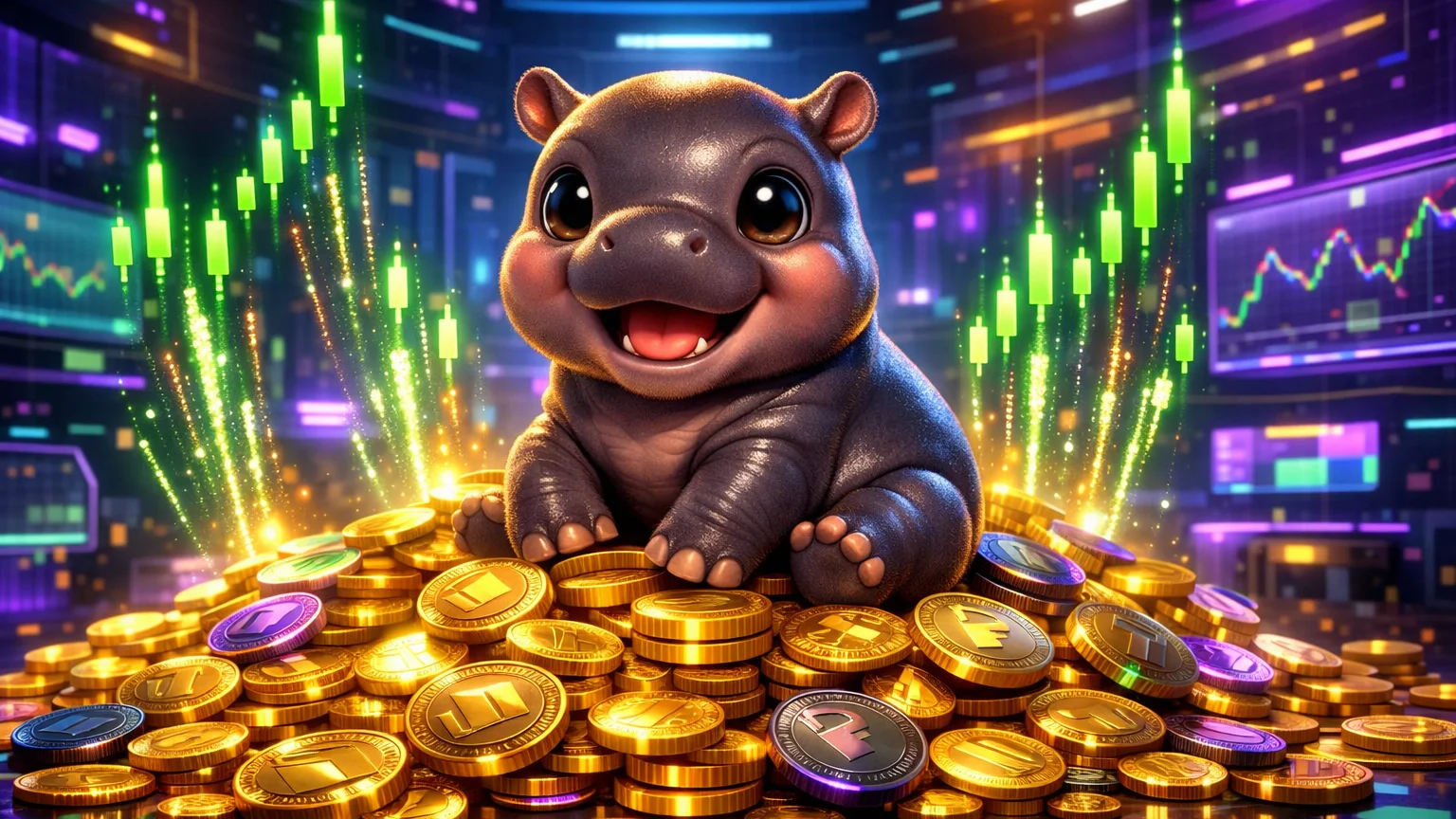
Arizona's Wildlife World Zoo named their new pygmy hippo Jellybean on live TV. Three days later, a Solana meme coin with the same name has ripped 10,456%, generated $5.6M in volume, and spawned an entire 'extended universe' of derivative tokens. Moo Deng walked so Jellybean could run.
No significant risks detected.
On February 23, Arizona's Wildlife World Zoo went live on NBC's TODAY show to reveal the name of their newborn pygmy hippo. Born January 22, the tiny hippo had been the subject of a public naming contest with candy-themed options: Cadbury, Twixi, Taffy, and Jellybean. The public voted. Jellybean won with 81.3% of the ballot. The zoo president smiled. America went 'aww.' And somewhere on Solana, the degeneracy machine was already spinning up.
Three days later, a meme coin called $Jellybean has ripped 10,456% from its launch, accumulated $5.6 million in trading volume, reached a $7 million market cap, and spawned at least one derivative token — $LOLLIPOP, branded as 'Jellybean's mom.' The community-claimed token has attracted 37,442 transactions across 14 trading pairs, with a dedicated website (jellybean.meme) and an active Twitter account (@jellybeanonsol). This isn't a random ticker riding a news cycle. This is the Moo Deng playbook, perfected.
• 10,456% gain with $5.6M volume and 37,442 transactions — this is a legitimate market event, not a bot farm\n• Community-claimed on Feb 24 (day after name reveal) — the organic takeover thesis is real\n• Already spawning derivatives: $LOLLIPOP (Jellybean's mom) pumped 3,088% in 4 hours\n• $285K liquidity against $7M mcap — a 4% ratio that provides some depth but remains fragile
The Moo Deng Playbook
If you were in crypto during late 2024, you remember Moo Deng — the baby pygmy hippo at Thailand's Khao Kheow Open Zoo that became a global internet sensation and spawned a constellation of meme coins. The Moo Deng meme economy at its peak represented hundreds of millions in market cap across multiple tokens. The thesis was simple: cute baby animal goes viral, internet makes it a meme, crypto financializes the meme, degeneracy ensues.
Jellybean is running the same playbook with better execution. The key differences: the name reveal happened on national television (TODAY show, not just social media), the community takeover was organized within 24 hours of the announcement, and the token already has professional infrastructure — a .meme domain, coordinated social accounts, and the kind of branding that suggests experienced meme coin operators, not random deployers.
DexScreener shows the token as 'community claimed' on February 24, one day after the name reveal. This timing is critical — it means the community organized, identified the best existing $Jellybean token (there were likely multiple launched simultaneously), and consolidated around it before the broader crypto audience caught on. That kind of coordination is what separates tokens that hit $7M from tokens that die at $50K.
The Numbers
The volume-to-mcap ratio of 0.8x is healthy and sustainable — significantly better than the manic 5-10x ratios we see in pure event coins. This suggests genuine market-making activity and two-way trading, not just a one-directional pump. The 37,442 transactions in 24 hours works out to roughly 1,560 trades per hour, indicating massive retail engagement across thousands of wallets.
The 14 trading pairs across Solana DEXes is unusually high for a meme coin of this age — most Pump.fun graduates operate on 1-3 pairs. This breadth of market access means the token is being picked up by aggregators and is findable across multiple trading interfaces, which drives organic discovery beyond DexScreener trending.
The liquidity of $285K is the strongest safety metric here. At 4% of market cap, it provides enough depth for most retail trades ($1K-$25K) to execute with manageable slippage. Compare this to $PINKSLIP ($19.7K liquidity) or most sub-24-hour Pump.fun launches ($5-15K) — Jellybean's liquidity pool is roughly 15-50x larger than its peers.
The Derivative Economy: Jellybean's Extended Universe
Perhaps the most telling signal of Jellybean's cultural penetration is the emergence of derivative tokens. $LOLLIPOP — branded as 'Jellybean's mom' — launched on Pump.fun and pumped 3,088% in four hours, generating $404K in volume. This is the 'franchise-ification' of meme coins in real time: a successful token spawns lore extensions, each one a new speculative vehicle riding the parent's momentum.
analysis flagged this as a significant editorial angle: 'the speed with which main character of the day memes get parents, cousins, and multiverse forks.' In the Moo Deng era, derivative tokens took days to emerge. In the Jellybean era, it took hours. The meme coin factory is getting faster, and the market's ability to narrativize, extend, and monetize a single cute animal moment is approaching real-time efficiency.
Why This Matters Beyond the Meme
The Jellybean phenomenon sits at the intersection of several trends that define the 2026 meme market. First, the 'IRL catalyst' thesis — tokens with real-world events behind them (zoo naming, political hearings, celebrity moments) consistently outperform purely internet-native memes. The TODAY show appearance gave Jellybean something most meme coins never have: mainstream awareness from a non-crypto audience.
Second, the 'community claim' mechanism represents an evolution in meme coin coordination. Rather than developers launching tokens and communities forming around them, communities are now forming first (around a viral moment) and then selecting which token to rally behind. This bottom-up coordination produces more organic holder distributions and stronger community attachment than top-down launches.
Third, the Moo Deng comparison sets both the bull case and the bear case. The bull case: Moo Deng tokens hit hundreds of millions in market cap, and Jellybean has better initial infrastructure and mainstream visibility. The bear case: Moo Deng also produced dozens of tokens that went to zero, and the animal-meme cycle may be showing signs of fatigue after multiple iterations.
The 1-hour surge of +69%. The token is still in active pump mode. While this generates excitement, it also means current buyers are purchasing at a significant premium to 24-hour lows. Any reversal from this level would be violent given the speed of the markup.
Community-claimed ≠ verified. DexScreener's community claim feature means a group has asserted stewardship over the token, but it doesn't verify the identities or intentions of those operators. The 'community' could be a coordinated group of insiders using the organic narrative as cover for distribution.
The animal meme cycle. Moo Deng, Pesto, and now Jellybean — each subsequent animal meme coin faces diminishing returns as the market pattern becomes recognizable. Traders who lost money on Moo Deng derivatives are less likely to chase the next one, creating a ceiling on how far animal memes can run before the meta exhausts itself.
Verdict
🟡 Speculative — Jellybean is the strongest organic culture-moment meme coin we've tracked this cycle. The IRL catalyst (national TV name reveal), the community coordination (claimed within 24 hours), the market metrics ($5.6M volume, $285K liquidity, 37K transactions), and the derivative economy (LOLLIPOP already pumping) all point to a token with genuine narrative legs. The Moo Deng comparison is both the bull thesis and the risk factor — it proves the playbook works but also that these cycles have a shelf life. At $7M mcap, there's significant room to run if the mainstream media picks up the 'zoo hippo becomes meme coin' story, but there's also a lot of air under the price if momentum stalls. The quality of execution here is institutional-grade by meme coin standards.
FAQ
What is Jellybean?
Jellybean is a baby pygmy hippo born January 22, 2026 at Arizona's Wildlife World Zoo. The name was chosen through a public vote (81.3% of ballots) and revealed on NBC's TODAY show on February 23. A Solana meme coin with the same name was community-claimed on February 24.
Is this like Moo Deng?
Yes — Jellybean follows the same playbook as the Moo Deng meme coin phenomenon from late 2024. Both involve baby pygmy hippos that went viral, spawning crypto meme economies. Jellybean has better initial infrastructure (dedicated website, 14 trading pairs, community coordination within 24 hours).
What is $LOLLIPOP?
LOLLIPOP is a derivative token branded as 'Jellybean's mom' that launched on Pump.fun after the original Jellybean token took off. It represents the 'extended universe' phenomenon where successful meme coins spawn lore-based sequels.
Is the zoo involved?
No. The Wildlife World Zoo has no connection to any cryptocurrency. The $Jellybean meme coin is an unauthorized community creation capitalizing on the viral naming event.