A Token Called 'It' Just Ripped 477% in 45 Minutes on Solana's Newest Launchpad
Letsbonk.fun is pumping out micro-cap graduates faster than pump.fun ever did, and the latest — a token with no name, no narrative, and no explanation — just proved the meta is the minimalism itself.
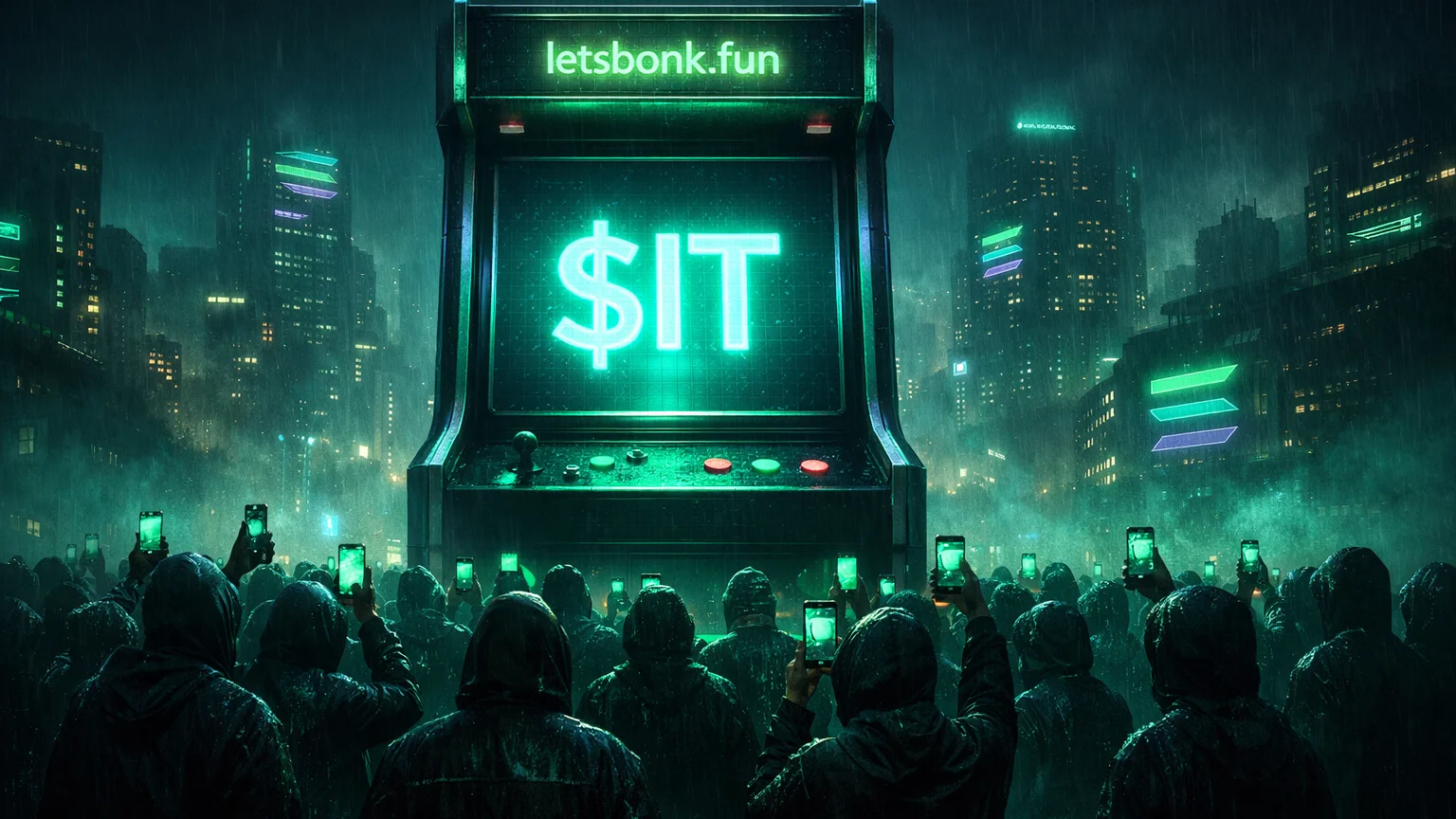
Forty-five minutes. That's how long it took a token called "It" — no subtitle, no tagline, no explanation — to rip 477% on letsbonk.fun, Solana's emerging launchpad challenger. By 3:45 PM UTC on March 23, $IT had processed 2,382 transactions across 150 holders, generating $89,600 in volume from what amounts to a two-character ticker and the collective agreement of 150 wallets that this was, in fact, it. The absurdity isn't accidental. It's the entire point.
- → $IT surged 477% within 45 minutes of launching on letsbonk.fun — Solana's newest pump.fun competitor
- → 150 holders, $89.6K volume, and a 60/40 buy-to-sell ratio suggest genuine degen discovery rather than coordinated insider activity
- → Market cap sits at $17.5K with just $4.5K in liquidity — this is a $500-or-less trade for anyone who values their stack
What Happened
Letsbonk.fun is doing what pump.fun did eighteen months ago — turning token creation into a spectator sport. The platform has been quietly building momentum as an alternative launchpad on Solana, and tokens graduating from its bonding curve are starting to hit Jupiter's trading feeds with enough velocity to catch DexScreener's attention. $IT is the latest graduate, and arguably the most philosophically interesting one. The token doesn't reference a celebrity, an animal, a political event, or a trending hashtag. It's called "It." The name is the narrative. The narrative is the name. It's almost aggressively meaningless — and that's what makes it work.
There's a growing meta on Solana around minimalist token naming. Tokens with one-word or even one-letter tickers that resist categorization have been outperforming their more descriptive counterparts. The thesis, if you can call it that, is that ambiguity creates projection. When a token is called "It," every buyer fills in their own meaning. It becomes whatever you want it to be — a pronoun, a reference, a Pennywise joke, a Seinfeld bit, a void. The less the token says about itself, the more the community says about it.
The Degen Translation
Crypto Twitter has been watching letsbonk.fun graduates the way it watched pump.fun graduates in early 2025 — with equal parts skepticism and FOMO. The platform's bonding curve mechanic creates a built-in graduation narrative: tokens that survive the curve and hit open trading on Jupiter are perceived as having "made it." That perception, thin as it is, creates a real momentum effect. Buyers see a letsbonk.fun graduate on Jupiter's cooking feed and treat it as social proof that the token already survived one filter.
$IT graduated fast. Sub-hour graduation into a 477% pump tells you the bonding curve filled quickly, which means a critical mass of wallets agreed this token had meme potential before it ever hit the open market. The 60% buy ratio after graduation means the momentum didn't die at the launchpad door — new buyers kept entering on Jupiter, which is the signal that separates graduates that pump-and-dump from graduates that develop a second leg.
The Numbers
The volume-to-market-cap ratio is 5:1, which is elevated but not as extreme as some launches. What's more interesting is the holder count. A hundred and fifty wallets in forty-five minutes for a token with zero marketing, zero social media presence, and a two-character name suggests organic discovery through Jupiter's cooking feed and DexScreener's new pairs. These aren't sniper bots — there aren't enough of them to generate 2,382 transactions. This is retail degens doing what they do: scrolling feeds, seeing a weird name, clicking, aping.
The buy-to-sell ratio holding at 60/40 in the first hour is a positive signal for momentum continuation. In most micro-cap launches, the ratio inverts within thirty minutes as initial buyers flip. The fact that buyers are still outpacing sellers at the forty-five-minute mark means either new wallets are still discovering the token, or existing holders believe there's more upside. Both scenarios support a short-term continuation thesis. Neither guarantees it.
What the On-Chain Data Shows
The deployer wallet for $IT is a first-time creator with a clean Rugcheck profile. Rug score of 1 out of 100 — essentially the lowest possible risk flag. No freeze authority. No mint authority. Zero danger-level risks detected. The contract address ends in "dubonk," confirming it was deployed through letsbonk.fun's factory contract rather than a custom deployment. This is standard for launchpad tokens and generally considered a positive signal — factory contracts use audited templates that limit the developer's ability to manipulate the token post-launch.
Holder concentration data is limited at this stage. With only 150 holders and forty-five minutes of trading history, the distribution is still forming. Early launchpad participants typically hold larger positions than later entrants, which means the current holder base is likely top-heavy. As volume continues and new wallets enter, concentration will naturally dilute — assuming the token survives past the first few hours. The absence of any freeze or mint authority means the deployer can't pull a mechanical rug through contract manipulation. That doesn't prevent an economic rug — early holders dumping their bags — but it removes the most egregious attack vector.
Is This Sustainable?
Probably not. And that's the honest answer for any 45-minute-old token with $4,500 in liquidity. A 477% pump in under an hour is spectacular, but it's also a compression of days worth of price discovery into minutes. The chart needs to digest those gains, and digestion for micro-cap Solana tokens typically means a 30-60% retrace within the first six hours. The question isn't whether $IT will retrace — it almost certainly will. The question is where the retrace finds support.
The cultural angle gives $IT slightly more staying power than a random ticker. Minimalist naming meta is real — tokens like "A", "Why", and similar single-concept tickers have shown the ability to build communities around the emptiness itself. If $IT catches a second wind through CT discovery or a letsbonk.fun feature, the holder base could expand enough to create a legitimate floor. But we're talking about a token that has existed for less time than a pizza delivery takes. Patience here means checking back in 24 hours, not in 24 minutes.
The Launchpad War
The bigger story behind $IT isn't the token itself — it's what letsbonk.fun represents. Pump.fun dominated Solana's token creation market for over a year, processing hundreds of thousands of launches and taking a fee on every graduation. Letsbonk.fun is the most credible challenger to emerge since pump.fun's peak. Its graduates are showing up on Jupiter's cooking feed with real volume and real holder growth, which means the platform's bonding curve is calibrated tightly enough to produce tradeable tokens rather than dead-on-arrival contracts.
For traders, the launchpad war is a signal amplifier. Competition between platforms means better graduation mechanics, lower fees, and more aggressive featuring of successful tokens. Tokens that graduate from letsbonk.fun carry a novelty premium right now — they're new, they're different, and they benefit from the "what is this platform?" curiosity that drove early pump.fun trading. That premium is temporary. Once letsbonk.fun becomes as familiar as pump.fun, its graduates will need to stand on their own meme quality. For now, the launchpad label itself is part of the trade.
MemeDesk Verdict
🟡 Speculative — $IT is simultaneously the dumbest and the smartest thing on Solana right now. A two-character ticker with zero narrative that ripped 477% in 45 minutes on a brand-new launchpad. The on-chain data is clean (rug score: 1, no freeze/mint authority), the buy ratio is still positive, and the minimalist naming meta has shown it can build communities from nothing. But $4,500 in liquidity and 150 holders make this a token that could evaporate by morning. If you're playing this, size it like a lottery ticket — not because the odds are bad, but because the liquidity demands it. The real alpha here might not be $IT at all — it's letsbonk.fun as a launchpad. Watch what graduates next.
What is It ($IT) crypto token?
$IT is a meme token launched on letsbonk.fun, a Solana-based token launchpad. It has no stated utility or roadmap — the token's entire identity is its minimalist two-character name. It graduated from letsbonk.fun's bonding curve and began trading on Jupiter on March 23, 2026.
What is letsbonk.fun?
Letsbonk.fun is a Solana token launchpad that uses a bonding curve mechanism similar to pump.fun. Tokens are created on the platform and must fill their bonding curve before graduating to open trading on Jupiter. It's emerging as a competitor to pump.fun in the Solana meme token space.
Is $IT token safe to buy?
The token has a clean Rugcheck profile with a rug score of 1/100, no freeze authority, and no mint authority. However, it's less than an hour old with only $4,500 in liquidity and 150 holders. Any position is extremely high risk due to thin liquidity and the token's novelty.
Why did $IT pump 477%?
The pump was driven by rapid graduation from letsbonk.fun's bonding curve followed by organic discovery on Jupiter's cooking feed. The minimalist name attracted curiosity-driven buyers, and the thin liquidity amplified every buy into significant price movement. The 60/40 buy-to-sell ratio suggests more buyers entering than sellers exiting.