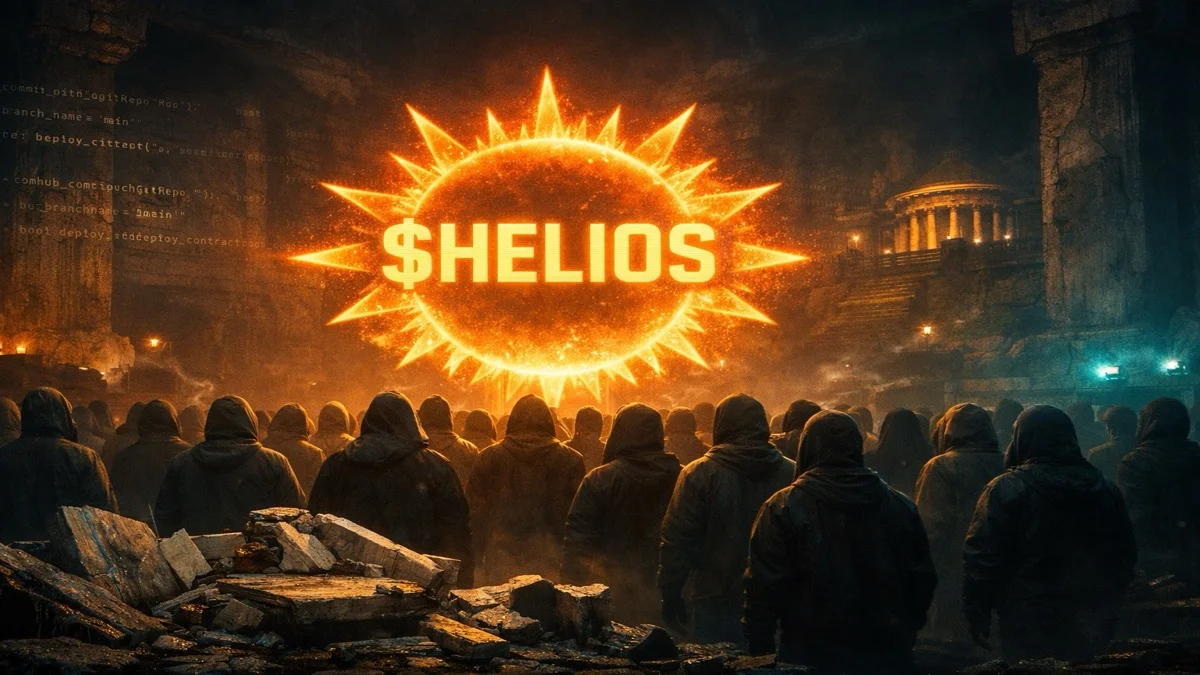
$HELIOS Did 5,965% After Its Dev Rugged — Because the Community Decided to Take It Back
A dead token found new life when scavengers discovered its contract address buried in the Helius SDK GitHub. Now it's a $176K CTO with $639K in volume and a governance coup origin story.
No major concentration risks. Healthy distribution with top holder at 9.7%.
The developer dumped and vanished. The chart flatlined. By every metric that matters in meme token markets, $HELIOS was dead. Then someone found the contract address sitting in a Helius SDK GitHub repository — and a group of degens decided that a dead token with lore was worth more than a live token without it. On March 12, $HELIOS ripped 5,965% as the community takeover (CTO) gained traction, pushing a corpse to a $176K market cap on $639K in volume.
- → $HELIOS posted a 5,965% gain after the community seized control from the original dev who rugged
- → The contract was discovered buried in Helius SDK GitHub — a hacker-scavenger origin story that writes its own lore
- → Top holder controls just 9.7% of supply — one of the healthiest distributions for a CTO micro-cap
What Happened
The original $HELIOS launched through pump.fun with what appeared to be a standard meme setup — Greek mythology branding, some sun god imagery, the usual. At some point, the developer decided the project wasn't worth the effort, dumped their holdings, and walked. The chart did what charts do when a dev exits: it cratered.
What happened next is the part that makes this a story worth telling. Community members — the kind of people who read GitHub commit histories for fun — discovered that the $HELIOS contract address appeared in Helius SDK documentation. Helius is a Solana infrastructure provider used by thousands of developers, and finding a meme token contract embedded in their open-source tools gave $HELIOS something no amount of marketing could buy: a genuine origin artifact.
The community declared a CTO — community takeover — and began rebuilding around this discovery. New socials were spun up. The narrative shifted from "abandoned meme token" to "the token that was found in the source code." It's the crypto equivalent of finding a treasure map in a library book. The lore writes itself, which is exactly why it's working.
The Degen Translation
Community takeovers are the defining meta of early-2026 Solana meme markets. The playbook has crystallized: don't cry about a rug — fork it, rebrand it, own it. Degens have learned that the emotional energy generated by a rug pull can be redirected. Anger becomes conviction, betrayal becomes bonding, and the shared experience of getting dumped on creates exactly the kind of cult-like community cohesion that meme tokens need to sustain price action.
But $HELIOS has something the typical CTO doesn't: a backstory that exists outside the token itself. The Helius SDK connection — whether accidental, a developer in-joke, or a test address that stuck — gives community members something to point to beyond "we decided this was ours now." In meme markets, narrative legitimacy is the closest thing to fundamental value, and a GitHub artifact provides exactly that.
The early-2026 Solana CTO trend has produced notable winners. Tokens like $CHILLGUY and several others started as abandoned projects before community takeovers transformed them into multi-million dollar market caps. The pattern is consistent: rug → community anger → CTO declaration → new narrative → speculative capital floods in → either a sustainable community forms or the second wave of sellers finish what the dev started.
The Numbers
The 5,965% move is the attention-grabber, but the structural numbers matter more for anyone evaluating this beyond the initial pump. Volume-to-mcap ratio of 3.6:1 is firmly in healthy speculation territory — high enough to indicate real interest, not so extreme that it screams pure churn. Compare that to bot-driven launches that routinely show 15:1 or higher.
The $23.7K liquidity pool is the constraint. This is still a token where a $3K market buy will move the price 10-15%. The infrastructure is micro-cap through and through, which means the 5,965% gain is as much a function of thin liquidity as it is genuine demand. Both can be true simultaneously — the demand is real, and the liquidity amplifies it.
What the On-Chain Data Shows
The Rugcheck profile is clean. Score of 16 out of 100 — low risk. No freeze authority, no mint authority. The original deployer wallet holds zero tokens, which is actually the expected outcome after a rug: the dev sold everything.
The holder distribution is where $HELIOS genuinely stands out. The top wallet holds just 9.7% of supply. The second and third largest are at 3.72% and 3.6%. Total top-3 concentration: 17.0%. For a micro-cap CTO token, this is exceptionally healthy. Most community takeovers see early CTO organizers scoop up 20-40% of supply at dead-chart prices before promoting the revival — the fact that no single wallet dominates suggests this was either a broadly organic recovery or the organizers were disciplined about distribution.
No insider flags on any of the top wallets. No connections to known rug operators. The on-chain picture is consistent with the narrative: a genuinely community-driven recovery rather than a coordinated pump by a small group masquerading as a CTO.
Is This Sustainable?
CTO tokens follow a specific lifecycle. The initial recovery pump — which is what we're seeing now — is fueled by the narrative itself: "look at this dead token coming back to life" is inherently shareable content. That pump typically lasts 24-72 hours before the market asks the harder question: what now?
The tokens that survive past the initial CTO pump are the ones that build something during the window of attention. A website. A Telegram community. Meme content. Partnerships (even informal ones). If $HELIOS can leverage the Helius SDK lore into something more — a developer-themed meme community, a hacker aesthetic brand, connections to the Solana dev ecosystem — it has ingredients that most CTOs lack.
The bear case is familiar. The dev already proved the project isn't worth maintaining. The community taking over inherits all the technical debt and none of the initial enthusiasm. The Helius connection might be nothing more than a test address, and when that narrative gets debunked or simply stops mattering, the chart follows. Most CTOs die within two weeks of the takeover. The 5,965% candle is likely the biggest move this token will ever make — the question is whether it stabilizes at a higher floor or retraces 90% of the gain.
There's also the meta-risk: CTO plays are becoming so common on Solana that the market is developing antibodies. The first wave of successful CTOs caught people off guard. Now everyone's looking for them, which means the edge is compressing. Each new CTO needs a stronger narrative to capture the same attention. The Helius lore gives $HELIOS an edge over generic "community took over" stories, but whether it's enough is a 48-hour question.
🟡 Speculative — $HELIOS hits the sweet spot of the CTO meta: a real rug with a real origin story and a genuinely distributed recovery. The Helius SDK discovery gives it narrative legitimacy that most CTOs can only dream of. But 5,965% moves on $23K liquidity are fragile by definition, and the CTO playbook has an expiration date. The on-chain data is clean — no insider concentration, no authority flags, distributed holders. If you're playing this, you're betting that the community can build faster than the narrative decays. That's a bet on people, not on a chart.
What is HELIOS crypto?
HELIOS is a Solana meme token that was originally launched and abandoned by its developer (rugged). The community discovered the contract address in a Helius SDK GitHub repository and performed a community takeover (CTO), reviving the project under new leadership.
What is a community takeover (CTO) in crypto?
A CTO occurs when a token's original developer abandons the project and community members take control. They typically create new social media accounts, establish governance, and attempt to rebuild the project. CTOs have become a significant trend on Solana in early 2026.
Is HELIOS safe to buy?
HELIOS has a low Rugcheck score of 16 (low risk), no freeze or mint authority, and healthy holder distribution with the top wallet at just 9.7%. However, it has only $23.7K in liquidity, making it extremely volatile. The original developer already rugged once. This is high-risk speculation.
What is the connection between HELIOS and Helius SDK?
Community members discovered the $HELIOS contract address referenced in the Helius SDK GitHub repository. Helius is a Solana infrastructure provider. This connection became the origin story and primary narrative driver for the community takeover.