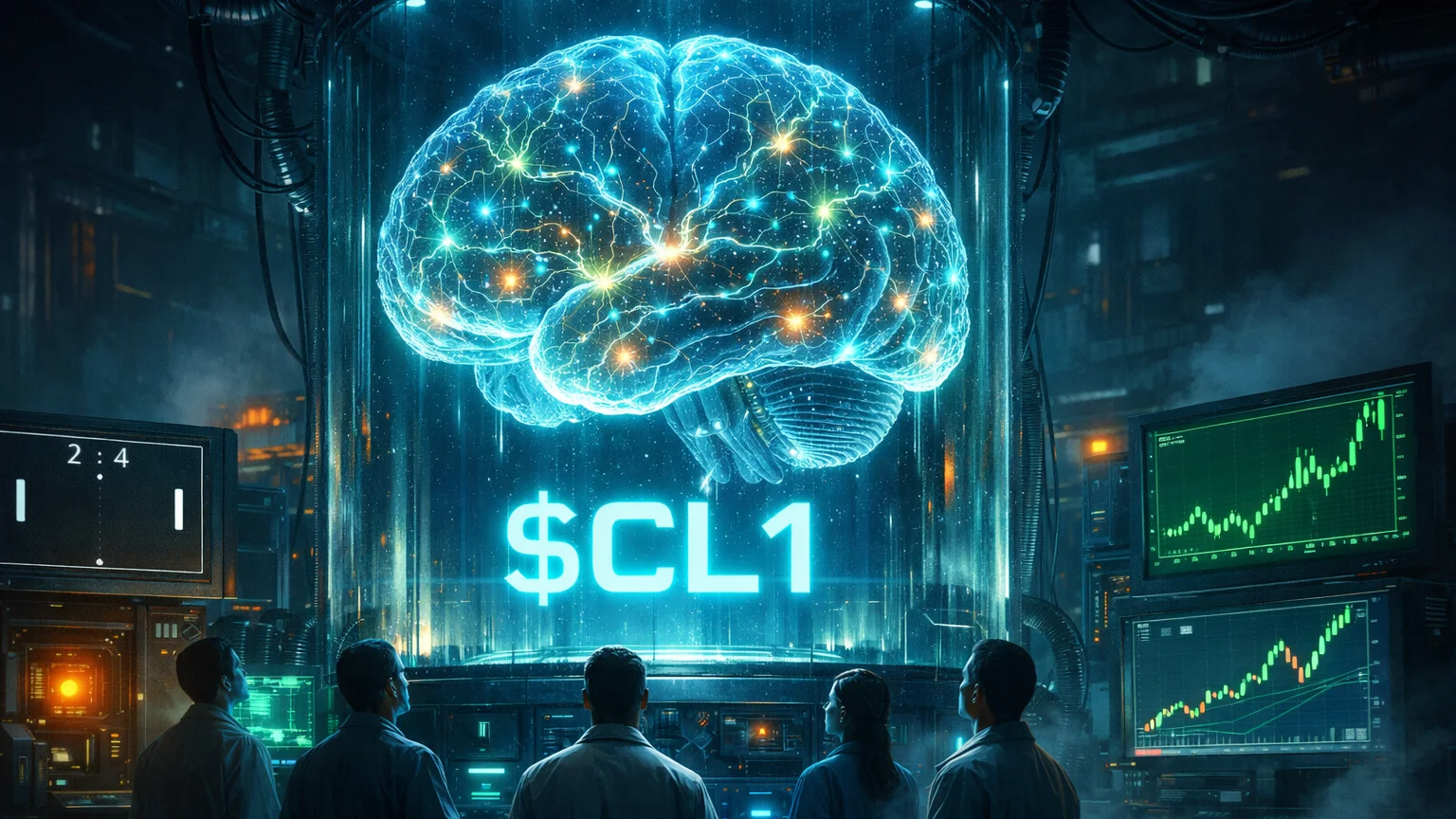
A $35K Brain-Cell Computer That Plays Pong Just Spawned a 1,293% Solana Pump
Lab-grown human neurons powering AI research became an unlikely meme coin catalyst. If biocomputing is the next trillion-dollar narrative, $CL1 holders are absurdly early. If it's just a novelty, they bought the peak of a science fair hype cycle.
No significant risks detected.
In a Melbourne laboratory, scientists grew human brain cells in a dish, taught them to play Pong, and called it DishBrain. The experiment made international headlines when Cortical Labs demonstrated that biological neurons could learn tasks faster than conventional AI — a $35,000 biological computer outperforming silicon at specific pattern recognition. Fast forward to Solana, where someone looked at this breakthrough and did what crypto does best: turned it into a meme coin. $CL1 has pumped 1,293% in seven days, pulled $1.6 million in daily volume, and is sitting at a $669K market cap with no signs of slowing down.
- → $CL1 is a Solana meme token riding the real-world biocomputing narrative from Cortical Labs — the company that taught lab-grown brain cells to play Pong
- → 1,293% gain over 7 days, $1.6M daily volume, $669K market cap with $93K liquidity — holding strength after a week is unusual for this tier
What Happened
Cortical Labs is a real company. Founded in Melbourne, Australia, they developed DishBrain — a system that cultures human neurons on multi-electrode arrays and trains them to perform computational tasks. Their most famous demonstration involved teaching these biological neural networks to play the classic game Pong. The research, published in the journal Neuron, showed that living brain cells could learn and adapt to stimuli in ways that complement traditional silicon-based computing. The company has raised venture funding and is positioning itself at the intersection of neuroscience and artificial intelligence.
The $35,000 price tag for their biological computer made headlines specifically because it highlighted how biological neurons might eventually be more cost-effective than GPUs for certain types of computation. In a world where NVIDIA's H100 chips sell for $30,000-$40,000 each and data centers burn billions in electricity, the idea of growing your compute power in a petri dish hit a nerve — no pun intended. This is the cultural moment $CL1 latched onto.
The Degen Translation
Crypto Twitter runs on narrative arbitrage — finding a real-world story before it gets priced in and building a financial instrument around it. The AI agent meta dominated the first quarter of 2026. DePIN had its moment. Biocomputing is the white space between both. It's AI, but biological. It's infrastructure, but organic. It's science fiction that's actually happening in a lab. The meme practically writes itself: 'They're literally growing brains to make computers and you're still buying dog coins.'
What makes $CL1 different from a random science-branded meme coin is that Cortical Labs is a funded, operational company with published research. This isn't a token pretending to do biocomputing — it's a derivative play on a real company's breakthroughs. That distinction matters because it gives the meme a renewable catalyst: every time Cortical Labs publishes new research, gets press coverage, or announces a partnership, $CL1 has a natural price catalyst. The token is essentially a decentralized prediction market on whether biocomputing becomes the next major tech narrative.
The Numbers
The volume-to-market-cap ratio tells the real story here. At 2.4x, this token is generating more daily trading volume than its entire market cap — a sign of intense speculative interest and active rotation. For context, most established meme coins operate at 0.1-0.3x ratios. The $93K liquidity pool is thin, which means both entries and exits will have significant price impact. A single $10K sell order would move the chart. But the fact that the token has held 1,293% gains over a full week — rather than the typical pump-and-dump pattern of spiking 500% in 4 hours and retracing 90% — suggests the thesis has stickiness.
The narrative strength here is a 9 out of 10. Biocomputing is exotic enough to feel novel but grounded enough in real science to not feel like a joke. The Cortical Labs connection provides legitimacy that pure meme plays lack. And the AI meta isn't dead — it's evolving. $CL1 represents the next evolution: not artificial intelligence, but biological intelligence tokenized.
Is This Sustainable?
The bear case: $CL1 has no official connection to Cortical Labs. The company hasn't acknowledged the token, isn't involved in its creation, and could actively distance themselves from it at any moment. A cease-and-desist tweet from Cortical Labs' official account would nuke the chart instantly. The $93K liquidity pool means any coordinated sell-off hits harder than it should. And the biocomputing narrative, while fascinating, is still niche — it hasn't crossed into mainstream CT consciousness the way AI agents or political memes have.
The bull case: biocomputing is genuinely one of the most underhyped technologies on the planet. If the narrative catches — if a single major tech outlet runs a 'biocomputing is the future of AI' piece, or if Elon tweets about brain-cell computers — $CL1 is positioned as the only liquid trade in the space. First-mover advantage in narrative meme coins is worth more than fundamentals. The token that captures a narrative first typically retains 60-70% of the category's volume even after competitors launch. And unlike most meme narratives, biocomputing has a steady pipeline of real-world catalysts: academic papers, conference presentations, funding announcements, and product demos from Cortical Labs and competitors like Koniku.
The 7-day hold is the most bullish data point. Most Pump.fun tokens follow a predictable arc: 4-8 hours of euphoria, followed by a multi-day bleed to zero. $CL1 broke that pattern. A week of sustained interest, even with thin liquidity, suggests the meme has deeper roots than the typical low-cap play.
MemeDesk Verdict
🟡 Speculative — $CL1 is the most intellectually interesting meme coin we've covered this month. The real-world anchor in Cortical Labs gives it a legitimacy moat that pure meme plays can't replicate, and the 7-day hold pattern breaks the typical Pump.fun lifecycle. But $93K liquidity on a $669K market cap is a red flag for anyone thinking about meaningful size. This is a narrative bet, pure and simple: you're wagering that biocomputing becomes the next AI-tier CT obsession before the liquidity dries up. The volume-to-MC ratio says money is paying attention. The 7-day hold says the thesis has legs. The zero KOL coverage says the biggest move might still be ahead — or that smart money already knows something we don't. Size accordingly.
What is $CL1 (Cortical Labs token)?
$CL1 is a Solana meme coin themed around Cortical Labs, a real biocomputing company that developed DishBrain — a system using lab-grown human neurons for computation. The token has no official affiliation with the company and exists purely as a speculative derivative play on the biocomputing narrative.
What is DishBrain and why does it matter?
DishBrain is a biological computing system developed by Cortical Labs that grows human neurons on multi-electrode arrays and trains them to perform tasks like playing Pong. The research, published in the journal Neuron, demonstrated that biological neural networks can learn and adapt, potentially offering a more energy-efficient alternative to silicon-based AI computing.
Why is $CL1 pumping on Solana?
$CL1 gained 1,293% over 7 days by capturing the biocomputing narrative at a time when CT is hungry for the next AI-adjacent meta. The real-world connection to Cortical Labs provides a legitimacy layer that most meme coins lack, and the 'brain cells playing Pong' meme is inherently shareable and fascinating.
Is $CL1 connected to the real Cortical Labs?
No. $CL1 is an unofficial meme token with no endorsement, partnership, or involvement from Cortical Labs. The company has not acknowledged the token. Buying $CL1 is a speculative bet on the biocomputing narrative, not an investment in the actual company.
What are the risks of buying $CL1?
Major risks include thin liquidity ($93K), no official backing from Cortical Labs (who could disavow the token), no doxxed team, and the niche nature of the biocomputing narrative. The token could lose 90%+ of its value in a single large sell order due to the shallow liquidity pool.