
Beach Baddies caught the tape, then reminded Solana why speed kills first
BADDIES pushed roughly $1.8 million of turnover through an $88K market cap in its first hours, but a brutal intrahour reversal and a 49% top-three holder cluster turned the setup into a post-pump exhaustion test.
Rugcheck removes the obvious contract-level traps with freeze authority disabled and mint authority disabled, but the top wallet alone controls 32.55% and the top three visible lines hold about 49% combined. That makes the chart more vulnerable to exhaustion than to a classic contract rug.
Beach Baddies did the hard part of a fresh Solana launch almost immediately: it forced people to look. By the 1:00 AM UTC selection snapshot on June 4, BADDIES had already pushed about $1.8 million of 24-hour turnover through a market cap sitting near $88K, with more than 19,000 transactions logged in the same window. That is the kind of speed that gets traders to stop pretending they are being selective. It also creates the exact market structure problem that ruins a lot of first-day boards. When turnover gets that loud before the market cap even reaches six figures, the chart stops being about discovery and starts being about whether fresh demand can outrun the people who already got the easy entries.
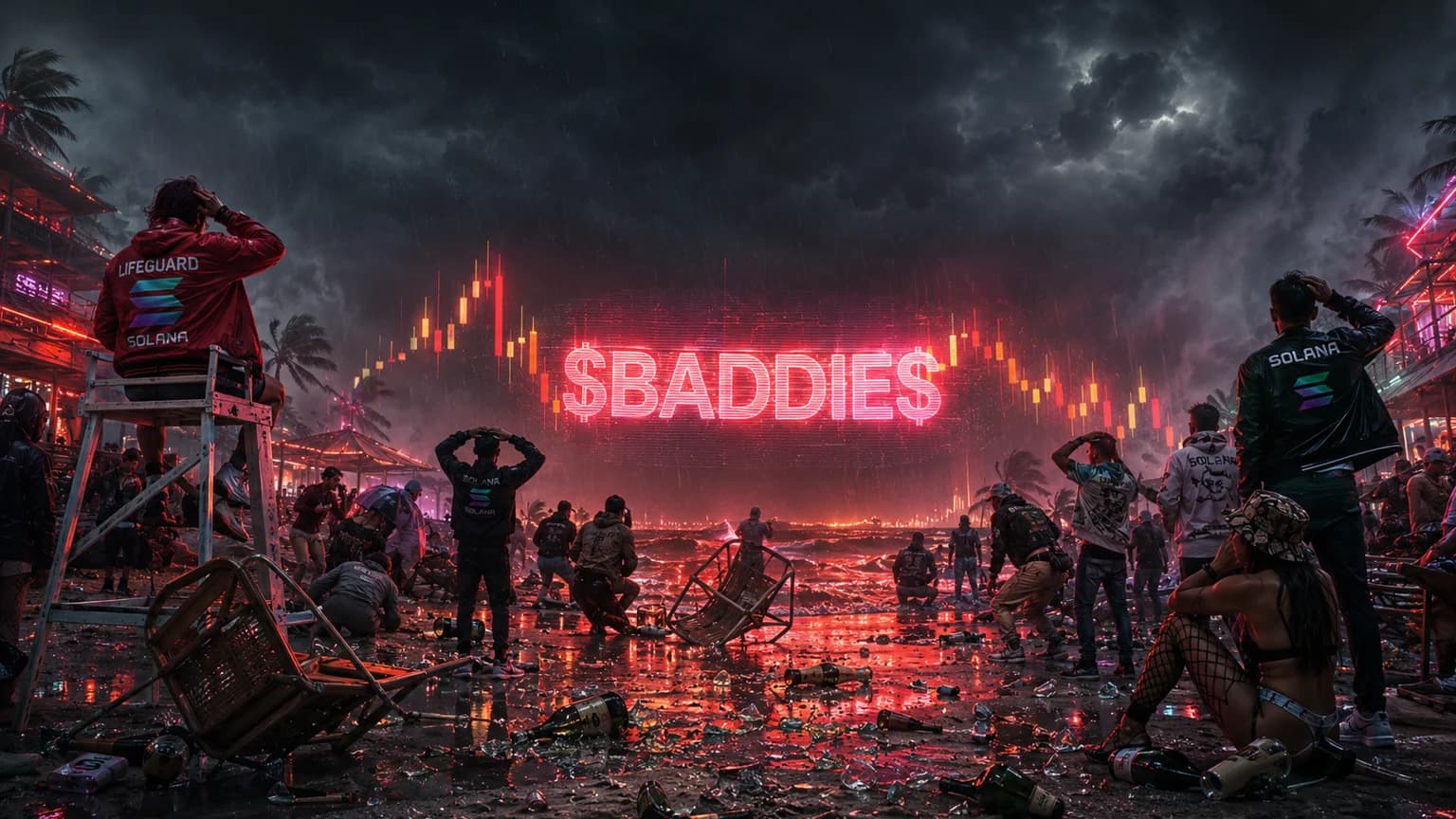
That second part is why BADDIES matters. The token was still showing a 186% 24-hour gain on the broad read, but the shorter tape looked nothing like a calm continuation. DexScreener's enriched snapshot had the one-hour move down 72.54% and the five-minute move down another 42.93%. The board did not merely cool off. It got punched in the mouth while everyone was still celebrating the headline volume number. That flips the story from clean runner to post-pump exhaustion. The meme may still have travel. The chart has already shown that the first buyers are not afraid to make later buyers hold the bag for a few candles.
- → BADDIES processed roughly $1.8 million in 24-hour volume against an $88K market cap and about $23.3K liquidity, which is enough turnover to make it a real board, not just a passing screenshot.
- → The catch is the reversal: the saved read showed a 72.54% one-hour drop and a 42.93% five-minute flush even while the broader 24-hour performance stayed green.
- → Rugcheck is relatively calm at a score of 16 with freeze authority and mint authority both disabled, but the top wallet controls 32.55% and the top three visible holder lines sit near 49%, so the tape can still get dictated by a small cluster.
Why The First Read Looked So Strong
The launch had the right ingredients for attention. BADDIES came with a coherent meme wrapper, a live X account, a Telegram room, and a website that at least tells traders there was an attempt to package the board instead of just throw a ticker into the ocean. More importantly, the early transaction count was serious. The enriched selection data logged 11,672 buys against 7,485 sells over 24 hours, with buy-side flow carrying about 60.9% of the tracked trade count. That kind of traffic does not happen because a deployer wallet bought its own chart three times. It means the token found actual participants fast.
That is what makes the chart worth discussing instead of dismissing. A lot of micro-cap Solana launches can print a big percentage off a microscopic base, then die before anyone with a functioning timeline notices. BADDIES was different because the activity level itself became the story. Nineteen thousand-plus transactions in a little over two hours is a crowd event. It tells you the token reached the point where multiple classes of trader are involved at once: the first snipers, the quick-flip crowd, the meme-first buyers, and the latecomers who only show up after the volume tab looks undeniable.
The Numbers Were Loud. The Liquidity Was Not.
The best way to read BADDIES is to stop treating volume as a comfort blanket. Yes, $1.8 million in turnover is huge for a token at this size. It is also more than twenty times the market cap and roughly seventy-seven times the available liquidity. That does not automatically mean strength. It can just as easily mean the same supply was getting hot-potatoed while the market scrambled to decide where fair value should land. When a board moves that much capital through that little depth, the market is not discovering price politely. It is stress-testing who gets trapped first.
That is exactly what the shorter time frames suggest happened. A -72.54% one-hour print is not noise. It is the market broadcasting that the first euphoric phase already found its sellers. The five-minute flush of nearly 43% makes the point even harder: liquidity may have been sufficient to create a spectacle, but not sufficient to protect late entries once early holders started taking the other side. In practical terms, BADDIES now needs a reset, not another victory lap. A second push matters only if it can happen without the same kind of air pocket opening underneath it.
What the On-Chain Data Shows
The contract-level read is cleaner than the price action. Rugcheck scored BADDIES at 16, which is not the kind of number that forces an immediate exit by itself. Freeze authority is disabled. Mint authority is disabled. There are no saved risk flags in the enriched profile that scream classic deployer abuse. That matters because it tells you the visible problem is not a cartoonish contract trap. The visible problem is market structure: who owns the supply, how much depth exists, and whether fresh buyers are stepping into a chart that already spent its first burst of momentum.
Holder concentration is where the optimism starts getting negotiated. The top wallet controls 32.55% of supply by itself. Add the second-largest line at 14.29% and the third at 2.13%, and the top-three cluster reaches about 49%. That is not a theoretical concern when the entire liquidity pool is around $23.3K. It means a relatively small set of wallets can still determine how violent the next candle looks. The deployer profile itself is not dramatic here. There is no serial-launch backstory worth manufacturing into lore. But the holder map does not need a villain to create pain. It only needs a few holders with much better entries than everyone who arrived after the volume spike.
- Rugcheck score sits at 16 with no freeze authority and no mint authority in the saved read
- The top wallet alone holds 32.55% of supply
- Top-three concentration is roughly 49%, which is a lot of supply for a board with only about $23.3K liquidity
The Bull Case Is A Cleaner Second Auction
There is still a real bullish argument, and it is not hard to see. BADDIES already proved it can recruit attention. The branding is clear enough to keep traveling on social timelines, the transaction count is high enough to show the token crossed out of pure sniper territory, and the broader 24-hour read stayed firmly positive even after the chart got clipped. That means the market has not fully abandoned the idea. If the board can stabilize, let liquidity hold, and then produce a second advance without instantly punishing every buyer, the narrative flips back toward one of those ugly-but-alive Solana launches that grind their way into a larger community.
That is the key distinction. A second bid is not automatically bullish if it looks identical to the first one. What bulls want is a cleaner auction. That means less verticality, fewer instant air pockets, and no meaningful worsening in the holder map. The board does not need to become a blue chip overnight. It just needs to show that new demand is willing to defend levels instead of only chase breakouts. If that happens, the first flush starts to look like normal launch violence rather than the moment the trade exhausted itself.
The Bear Case Is That The Best Part Already Happened
The harsher read is straightforward: BADDIES may have already spent the only effortless part of its move. When a token prints huge turnover early, then immediately loses structural composure, it often means the easiest audience has already been monetized. The meme got the clicks. The chart got the first buyers paid. Everyone after that is negotiating with weaker liquidity and stronger supply. That does not require a rug or a hidden contract trap. It only requires a board where the people with the best entries do not need to be patient.
That is why this stays a speculative read instead of a green badge. The clean parts of the setup are real, but so is the evidence of exhaustion. Traders watching BADDIES should care less about whether the token can print another big percentage and more about what kind of market structure produces that percentage. A rebound driven by steadier depth, tighter spreads, and calmer shorter time frames is a real improvement. A rebound that immediately turns back into a volatility contest is just another opportunity for someone else to sell the idea of momentum after they already got paid.
🟡 SPECULATIVE - Beach Baddies has already proven it can command attention, but the first live test of that attention ended in a sharp exhaustion move. The contract-level read is relatively clean, yet the holder map remains heavy and the liquidity base is too small to ignore. If BADDIES comes back with a steadier second auction, it can stay on radar. If it repeats the same vertical pump-to-flush pattern, the first headline volume burst will look less like confirmation and more like the whole trade.
Why is Beach Baddies on MemeDesk radar?
Because BADDIES logged roughly $1.8 million in 24-hour turnover, more than 19,000 transactions, and a 186% daily move within its first hours on Solana. That kind of speed is rare enough to matter.
What is the biggest BADDIES risk right now?
The biggest risk is post-pump exhaustion. The saved read showed a 72.54% one-hour drop and a 42.93% five-minute flush, which means the chart already proved it can punish late entries fast.
Does BADDIES have obvious contract-level rug risk?
The saved Rugcheck profile is relatively calm with a score of 16, freeze authority disabled, and mint authority disabled. That reduces classic contract-level concerns, but it does not remove holder-concentration or liquidity risk.
What would improve the BADDIES setup from here?
A stronger setup would show a second push with steadier shorter time frames, stable or improving liquidity, and no worsening in the holder distribution. In other words, the board needs a cleaner second auction, not just another loud candle.