American Oil Reserve Pumps 7,305% as Iran Strikes Trigger Energy Panic on Solana
Operation Epic Fury targeted Iranian oil infrastructure. Within hours, Solana degens had tokenized the energy crisis — and $AOR is the result.
No significant risks detected.
When U.S. and Israeli forces launched Operation Epic Fury against Iranian military and nuclear infrastructure on Saturday night, the immediate market reaction was predictable: Bitcoin dropped, $521 million in crypto positions were liquidated, and risk-off sentiment swept through every asset class. But the second-order reaction — the Solana reaction — was anything but predictable.
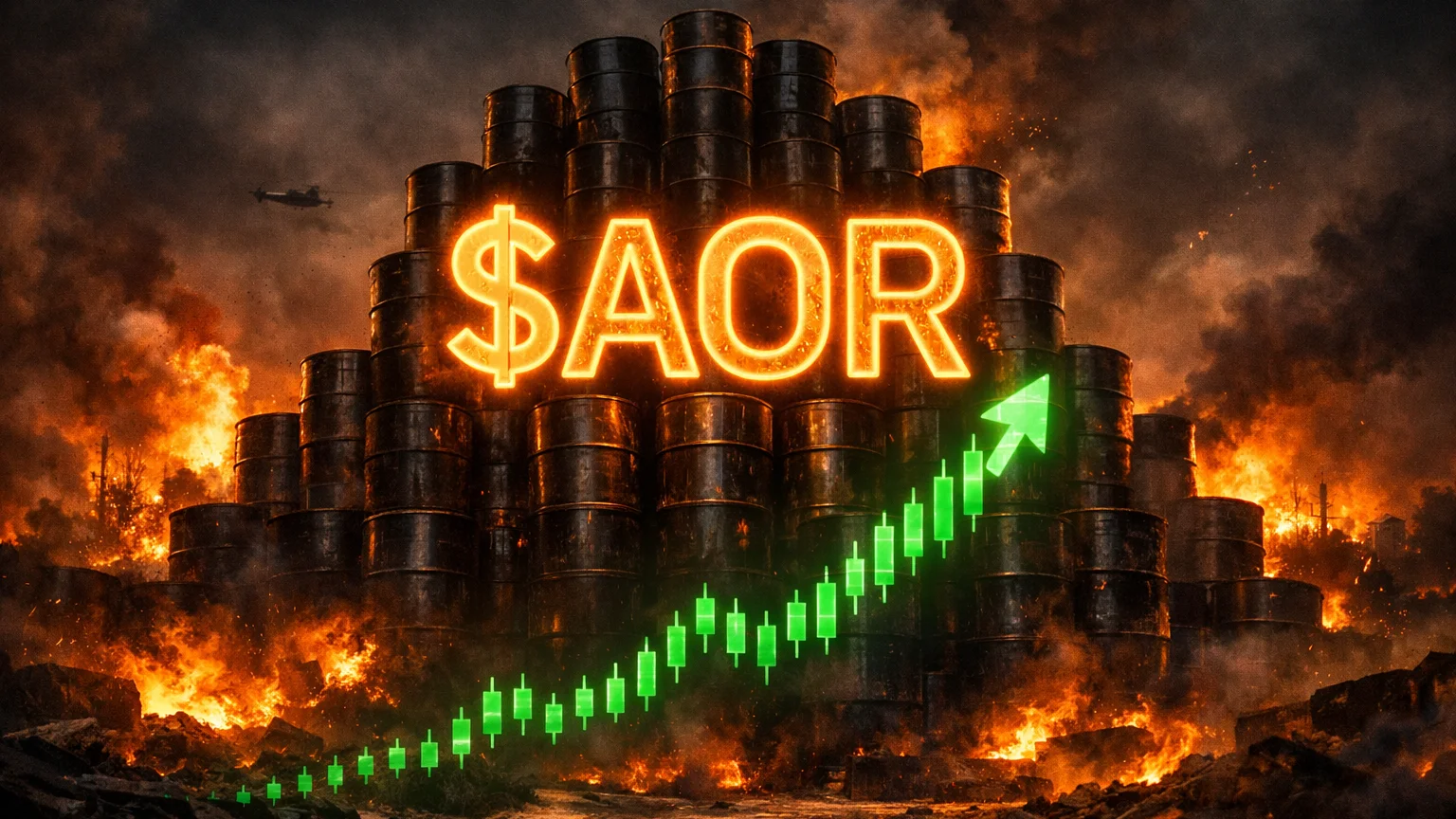
Within hours, a token called American Oil Reserve ($AOR) appeared on Solana and promptly pumped 7,305%. Not 73%. Not 730%. Seven thousand three hundred and five percent. With $727K in trading volume, $188K in liquidity, and a 67% buy ratio, $AOR has become the highest-performing geopolitical derivative token in the current crisis cycle — and it's doing so by financializing the one thing everyone is actually worried about: oil.
While other war memes focused on military operations (EpicFury) or cultural commentary (WarClaude), $AOR cuts to the economic heart of why Iran matters to global markets. It's not about the bombs. It's about the barrels.
- → The catalyst: Operation Epic Fury targeted Iranian military and oil infrastructure, raising fears of supply disruption in global energy markets
- → The token: American Oil Reserve ($AOR) on Solana — +7305% in 24 hours, $727K volume, $188K liquidity, 67% buy ratio across 4,963 transactions
- → The angle: While other war memes trade the conflict, $AOR trades the economic consequence — energy supply fear
- → The liquidity: $188K — the deepest liquidity pool of any geopolitical meme token in this cycle
What Happened: Bombs, Barrels, and Blockchain
The energy market implications of Operation Epic Fury are not hypothetical. Iran is OPEC's third-largest producer, pumping approximately 3.2 million barrels per day. Any sustained disruption to Iranian oil production or export infrastructure would create immediate supply pressure on global crude markets. When the strikes hit, oil futures spiked on fear alone — before any actual production damage was even confirmed.
Traditional energy markets have mechanisms for trading this fear: crude oil futures, energy ETFs, oil company equities. But those markets are closed on weekends. Crypto never closes. And Solana never sleeps.
This is the gap that $AOR fills. It's a 24/7, permissionless vehicle for speculating on energy supply fear — accessible to anyone with a Solana wallet, tradeable at any hour, and priced in real-time based on collective sentiment about whether the Iran situation will disrupt oil flows. It's not backed by actual oil reserves (obviously). It's backed by the market's belief that oil is the real story here — and so far, that belief has driven $727K in volume.
The 'American Oil Reserve' name is doing serious work. It evokes the Strategic Petroleum Reserve (SPR), the U.S. government's emergency oil stockpile, which has been a politically charged topic since the Biden-era drawdowns. By naming the token after a concept that already lives in the American political consciousness, the creator tapped into existing cultural infrastructure — everyone knows what an oil reserve is, everyone knows why it matters, and everyone knows that when bombs fall on oil countries, reserves become headlines.
The Numbers: Why 67% Buy Ratio Matters
The on-chain data for $AOR tells a story of sustained accumulation — not a pump-and-dump.
At 67% buy ratio across 4,963 transactions, $AOR has the highest buy pressure of any geopolitical token in the current cycle. For comparison: WARBROS had 57%, EpicFury had 63%, and WarClaude had 62%. A 67% buy ratio at 24 hours old means that for every 3 transactions, 2 are buys and 1 is a sell. New money is entering at twice the rate that existing holders are exiting.
The $188K liquidity pool is a standout figure. In the war meme meta, most tokens operate with $20-50K in liquidity. $AOR's pool is 4-8x deeper, which means: (a) the token can absorb larger trades without catastrophic slippage, (b) traders can enter and exit with more confidence, and (c) the price action is more reflective of genuine market sentiment rather than single-whale manipulation.
Volume of $727K against an unclear market cap (DexScreener shows n/a, suggesting the token may use a non-standard structure) is significant. The 4,963 transactions suggest broad retail participation — roughly 200 transactions per hour across hundreds of wallets. This isn't a handful of insiders trading back and forth.
The +7,305% gain is the most dramatic of any token in the scanner's top 15 this cycle. While extreme percentage gains on low-cap tokens are common, the combination of that gain with 67% buy pressure and $188K liquidity suggests the pump has structural support, not just momentum.
The Oil Narrative: Deeper Than Most War Memes
What sets $AOR apart from the broader war meme meta is that it's trading a specific, quantifiable economic risk rather than abstract geopolitical sentiment.
When you buy EpicFury, you're betting on continued attention to the military operation. When you buy WarClaude, you're betting on the intersection of AI and warfare staying in headlines. But when you buy $AOR, you're — at least symbolically — betting on oil supply disruption. That's a thesis that's been embedded in global markets since the 1973 oil embargo. Every analyst, every fund manager, every energy trader on the planet is watching the same risk right now. $AOR just made it tradeable on Solana.
The oil angle gives $AOR a natural catalyst chain that other war memes lack. If Iran retaliates by targeting oil infrastructure in the Gulf — as it has threatened — oil prices spike and $AOR's narrative strengthens. If the Strait of Hormuz (through which 20% of global oil passes) becomes a flashpoint, the energy fear narrative goes parabolic. If OPEC calls an emergency meeting, the oil supply conversation dominates headlines for days. Each of these scenarios is plausible and would drive volume to the token that most directly represents the oil thesis.
Even the 'American' prefix adds narrative resilience. The U.S. is simultaneously the world's largest oil producer AND the country conducting the strikes. The tension between American energy independence and American military action in oil-producing regions is a narrative that writes itself — and it's a conversation that could sustain for weeks, not hours.
The Broader Pattern: Commodity Memes Are New
Meme tokens have financialized people (TRUMP, MELANIA), animals (DOGE, BONK), AI concepts (GOAT, Pippin), cultural moments (ClaudeGate), and military operations (EpicFury). But $AOR represents something new: a commodity meme.
A commodity meme token doesn't track the actual commodity price (that's what futures are for). Instead, it trades the narrative around the commodity — the fear, the speculation, the political implications. When someone buys $AOR, they're not hedging oil exposure. They're expressing a view that 'oil is the story right now' in the most direct, permissionless way available.
This has interesting implications for future meme cycles. If $AOR proves that commodity-narrative tokens can generate sustained volume, expect to see similar tokens for every commodity that hits headlines: gold during banking crises, wheat during supply chain disruptions, lithium during EV policy announcements. The meme token market may be evolving from cultural commentary into a pseudo-prediction market for macroeconomic themes.
Is This Sustainable? The Oil Floor
The bull case: the Iran crisis isn't over. If anything, it's just beginning. Retaliatory strikes, diplomatic fallout, OPEC emergency sessions, Strait of Hormuz tensions — each is a plausible near-term catalyst that would drive volume to the oil narrative. The 67% buy ratio suggests the market agrees that there's more upside. And the $188K liquidity provides a trading floor that most war memes can't match.
The bear case: 7,305% in 24 hours is the kind of gain that attracts profit-takers. Early holders are sitting on 73x returns and have every incentive to distribute. If the Iran situation de-escalates quickly — a ceasefire, diplomatic breakthrough, or simple attention fatigue — the oil fear narrative deflates and the token bleeds. The unknown market cap makes it harder to assess fair value, adding uncertainty to any position.
The wildcard: if oil prices actually spike meaningfully on Monday when traditional markets open, $AOR becomes the crypto market's only real-time proxy for energy fear over the weekend. That could drive a second wave of volume as traders who couldn't access futures use $AOR as a proxy bet. Conversely, if oil opens flat on Monday, the narrative collapses.
Verdict: 🟡 Speculative
American Oil Reserve is the most structurally interesting geopolitical meme token in the current cycle. Unlike pure war memes, it trades a specific, quantifiable economic fear — oil supply disruption — that gives it a deeper catalyst chain and broader audience. The 67% buy ratio and $188K liquidity are the strongest on-chain signals of any war-era token. But 7,305% in 24 hours creates extreme distribution risk, and the token's sustainability depends entirely on whether the Iran crisis continues to threaten energy markets. If oil spikes on Monday, $AOR has legs. If it doesn't, this was a weekend trade.
What is American Oil Reserve ($AOR)?
AOR is a Solana meme token that financializes energy supply fear following the U.S.-Israel Operation Epic Fury strikes on Iran. Named to evoke the Strategic Petroleum Reserve, it serves as a speculative proxy for oil disruption sentiment in the crypto market.
Why did $AOR pump 7,305%?
Operation Epic Fury targeted Iranian infrastructure including oil-related assets. Iran produces 3.2M barrels/day as OPEC's third-largest producer. The token captured energy supply fear that traditional oil markets couldn't price over the weekend (futures markets were closed).
Is $AOR backed by real oil?
No. $AOR is a meme token with no underlying asset, no reserves, and no team obligations. It's purely a speculative vehicle for trading sentiment around oil supply disruption. It is not an oil ETF, commodity derivative, or any form of asset-backed token.
How does $AOR compare to other war meme tokens?
$AOR has the deepest liquidity ($188K vs $20-50K for most war memes) and highest buy ratio (67%) in the current geopolitical cycle. Its commodity-narrative angle differentiates it from pure military memes (EpicFury) and AI-war mashups (WarClaude).