$571K in Volume, 13,000 Transactions, and a 92% Crash: Inside the MEMECLAW Collapse
An AI meme engine built on OpenClaw hype pulled $571K through the pump.fun grinder in under 10 hours — then evaporated to a $2,700 market cap. Here's exactly how the machine ate itself.
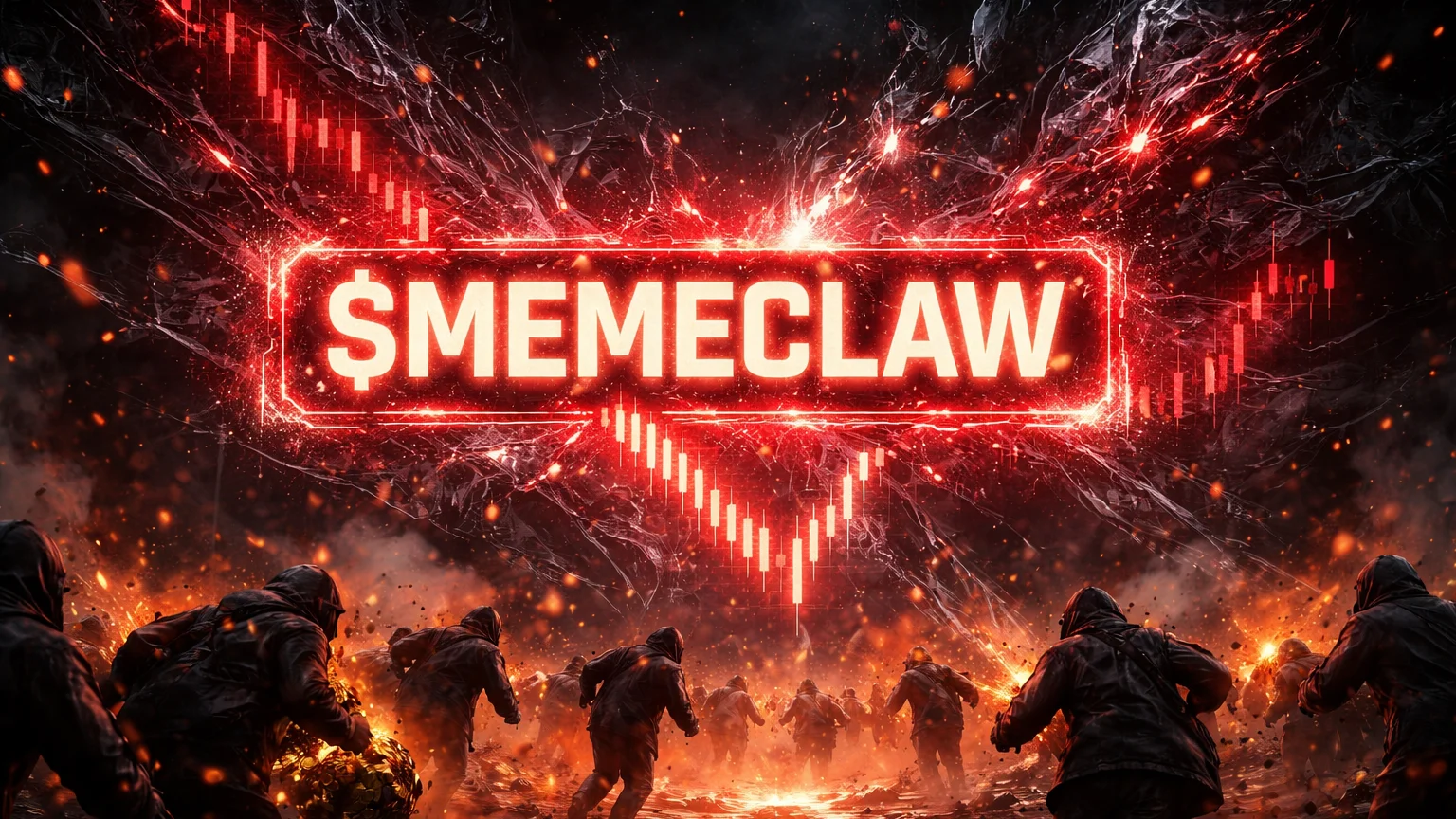
At approximately 8:00 AM UTC on March 29, 2026, a token called MEMECLAW appeared on pump.fun with a simple pitch: an AI-powered meme engine, derivative of Jason Levin's OpenClaw demo, purpose-built for viral content creation. Within hours, it ripped through $571,000 in trading volume across 13,372 transactions. By 6:00 PM UTC — less than ten hours later — the market cap had collapsed from its peak to $2,760. The meme engine ran out of fuel before most people even noticed it existed.
- → MEMECLAW launched as an AI meme engine derivative of OpenClaw, pulled $571K volume and 13K+ transactions in under 10 hours before crashing 92%
- → A single wallet controls 75.5% of the total supply — the textbook anatomy of a concentration-driven dump
- → Market cap collapsed to $2,760 with only $4,194 in remaining liquidity — this token is functionally dead
How It Went Down
MEMECLAW rode a wave that's become depressingly familiar in 2026: take a trending AI project, slap a derivative token on pump.fun, and let degen reflexes do the rest. OpenClaw — the legitimate AI agent framework by Jason Levin — had been generating buzz across Crypto Twitter. Someone saw the momentum and launched MEMECLAW, positioning it as an "AI meme engine for viral content creation" built on OpenClaw's concepts.
The launch hit at the perfect window. Buy ratio sat at 60%, suggesting genuine retail FOMO rather than pure bot activity in the early hours. Transactions stacked up at a blistering pace — 13,372 in under ten hours averages out to roughly 22 transactions per minute, sustained. Volume hit $571,000, which for a pump.fun launch with zero team, zero product, and zero roadmap is a testament to how powerful narrative proximity can be.
Then the chart did what these charts always do. The selling pressure arrived in waves, each bounce lower than the last, until the market cap cratered to $2,760 — a number so small that the remaining $4,194 in liquidity is essentially the token's entire economic existence.
The Red Flags Everyone Missed
The biggest red flag was hiding in plain sight on-chain, and it's damning: a single wallet — VxhgeMDkNXs7YXhXebNxpvCN1W84SFii7VNHU3VL1vm — holds 75.52% of the entire MEMECLAW supply. A second wallet holds 20.7%. Between them, two addresses control over 96% of every MEMECLAW token in existence. This isn't a distribution problem. This is a "the supply never left the inner circle" problem.
The deployer wallet (SZV39kAUnuGrhv3569jJzai5PxXoWq8LE2cTxEhKR4s) is a first-time deployer with zero other token launches — no track record, no history, no accountability trail. The Rugcheck score came back at 25 (relatively low risk), with no freeze authority and no mint authority, which means the token's mechanics were technically clean. But mechanical cleanliness means nothing when two wallets own everything. You don't need a freeze function when you can just market-sell 96% of supply.
The narrative connection to OpenClaw was pure marketing fiction. There was no partnership, no integration, no code shared. MEMECLAW was a name riding the coattails of a legitimate project — a derivative in the most literal and least flattering sense. Anyone who spent thirty seconds checking the OpenClaw GitHub would have known this. Almost nobody did.
The Receipts
The on-chain picture tells the whole story. With the top holder sitting on three-quarters of supply and a second wallet controlling another fifth, the $571K in volume was essentially retail money flowing into a pre-loaded exit. The buy ratio of 60% suggests real humans were buying — but they were buying into a supply structure that made the outcome inevitable. When concentration is this extreme, price discovery isn't real. It's theater.
What makes this case study particularly instructive is the rugcheck profile: no freeze authority, no mint authority, low risk score. Every automated scanner would have given this token a passing grade. The risk wasn't in the contract mechanics — it was in the allocation. Tools that only check for malicious code miss the most common meme coin kill shot: someone simply owning too much and selling.
Lessons for Degens
First and most obvious: check the holder distribution before you ape. Not after. MEMECLAW's top-holder data was publicly available on Solscan from minute one. A 75% single-wallet concentration should end the conversation before it starts, regardless of how compelling the narrative sounds. If two wallets own 96% of supply, you're not trading a market — you're providing exit liquidity.
Second: narrative proximity is not value. MEMECLAW had no technical relationship with OpenClaw. The name was the product. This is a pattern that repeats every cycle — legitimate projects generate buzz, and derivative tokens appear within hours to siphon that attention into pump.fun launches. The original project gets associated with a rug it had nothing to do with, and retail gets a -92% portfolio line item.
Third: rugcheck scores are necessary but not sufficient. A low risk score with no freeze or mint authority tells you the contract won't mechanically rug you. It doesn't tell you that two wallets can crash the price to zero by simply deciding to sell. On-chain scanners are tools, not oracles. Pair them with holder analysis or accept the consequences.
Fourth: 13,000 transactions in ten hours feels like momentum. It was. But momentum in a 96%-concentrated supply is just velocity toward zero. High transaction counts on pump.fun launches can be misleading — much of it is bots, arbitrage, and the same wallets churning volume. Without holder growth and distribution improvement, transaction count is noise.
MemeDesk Verdict
🔴 Confirmed Dead — MEMECLAW was a derivative token with zero connection to OpenClaw, launched with extreme supply concentration (96.2% in two wallets), and followed the most predictable pump.fun trajectory possible: fast volume, faster collapse. The $571K that flowed through this token is gone, redistributed from buyers who didn't check the holder tab to sellers who already had their exit planned. At $2,760 market cap and $4,194 in liquidity, MEMECLAW isn't coming back. It was never meant to last.
FAQ
What is MEMECLAW crypto?
MEMECLAW was a Solana meme token launched on pump.fun that marketed itself as an AI-powered meme engine derived from OpenClaw. It had no actual connection to the OpenClaw project and collapsed 92% within 10 hours of launch.
Is MEMECLAW related to OpenClaw?
No. MEMECLAW borrowed the name and AI narrative from OpenClaw (an AI agent framework by Jason Levin) but had no technical integration, partnership, or shared codebase. It was a derivative token riding the buzz.
Why did MEMECLAW crash?
Extreme supply concentration was the primary cause. Two wallets controlled over 96% of the total supply. When selling began, there was no distributed holder base to absorb the pressure, and the token collapsed from peak to $2,760 market cap.
Can MEMECLAW recover?
Extremely unlikely. With $4,194 in remaining liquidity, a $2,760 market cap, and 96% of supply in two wallets, there's no economic foundation for a recovery. The token is functionally dead.
How do I avoid tokens like MEMECLAW?
Always check holder distribution before buying. Use tools like Solscan or Birdeye to see top wallet percentages. If a single wallet holds more than 20% of supply (outside of known exchange wallets or burn addresses), proceed with extreme caution or skip entirely.