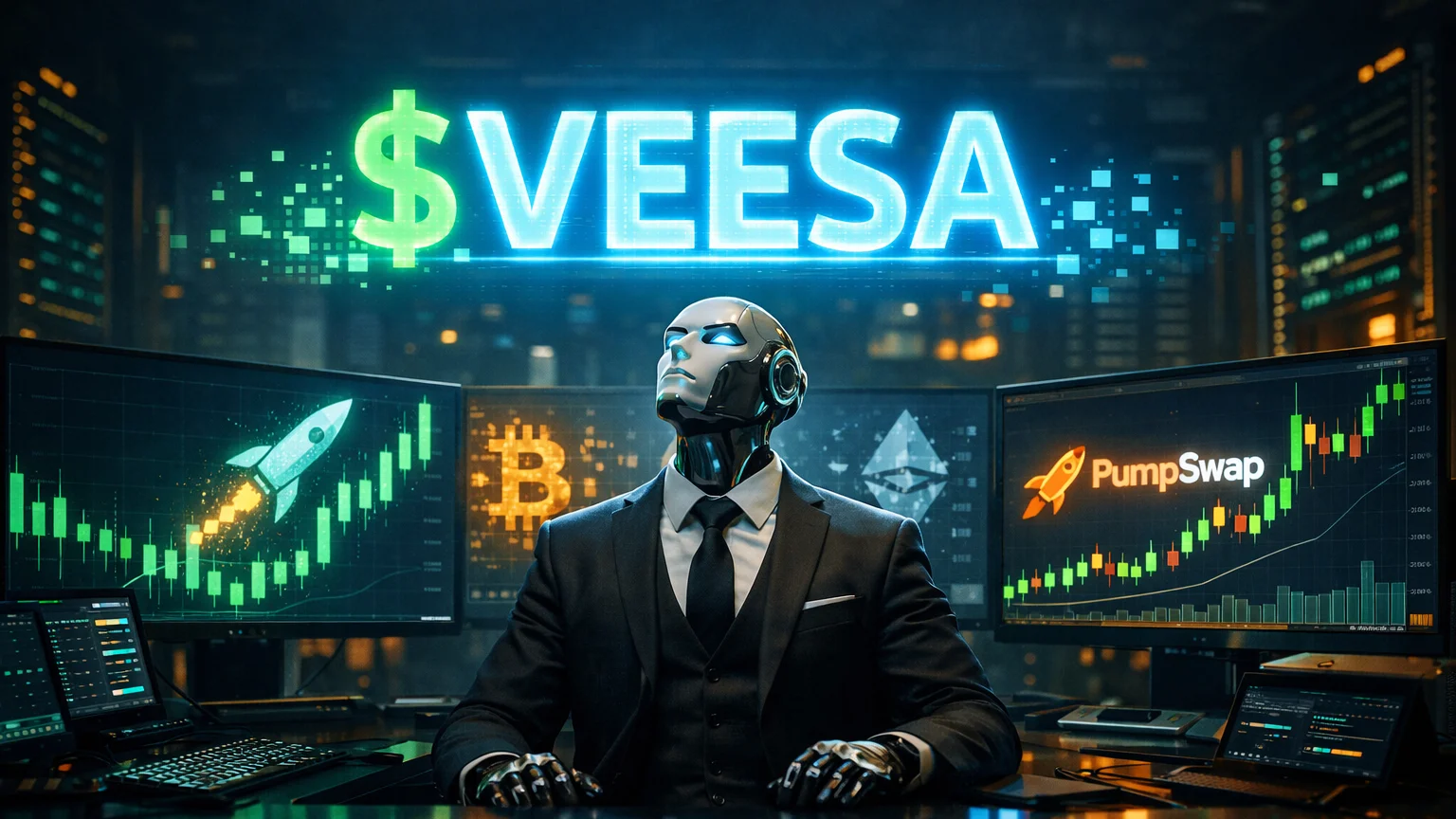
$VEESA Rips 1,543% in 7 Hours — AI Corporate Satire Meets PumpSwap Mania
A meme token mocking corporate AI culture just topped PumpSwap's trending page with $3M in volume. If the AI-meme narrative has legs, this is ground zero. If it doesn't, you're buying the exit liquidity.
No major concentration risks
At approximately 3:15 AM UTC on March 16, a token called VEESAINC — ticker $VEESA — launched on pump.fun and immediately started doing things that most meme coins only dream about. Within seven hours, it had printed a 1,543% gain, pushed $2.96 million in trading volume, and climbed to the top of PumpSwap's trending page on DexScreener. The premise: a fictional AI corporation that satirizes the hollow corporate jargon Silicon Valley uses to sell machine learning products to people who don't understand them. Think Dilbert meets GPT-4, tokenized on Solana, and injected directly into the degen bloodstream.
- → $VEESA launched 7 hours ago and has already done $2.96M in volume with a $621K market cap — a volume-to-mcap ratio of nearly 5:1
- → 37,539 transactions with a 63% buy ratio suggest aggressive accumulation, not just wash trading
- → Top 3 wallets hold only 11.4% of supply — unusually distributed for a token this young
What Makes This One Different
The AI-meme crossover isn't new. We've seen $GOAT, $AI16Z, and a dozen other attempts to ride the intersection of artificial intelligence hype and degen speculation. Most of them leaned hard into the AI agent narrative — autonomous systems, on-chain intelligence, the future of finance. VEESA does the opposite. It's not building anything. It's mocking the builders.
VEESAINC positions itself as a fictional corporate entity — complete with a website at veesainc.fun, a Twitter presence (@veesainc), and a Telegram community. The satire targets the corporate AI playbook: meaningless buzzwords, boardroom presentations about "synergizing neural pathways," and the kind of LinkedIn-brained enthusiasm that makes actual AI researchers cringe. It's a narrative bet that resonates precisely because everyone in crypto has been drowning in AI hype for months.
The timing matters. March 2026 has been dominated by AI agent fatigue — the meta that defined late 2025 has cooled significantly, with most AI tokens bleeding 60-80% from their highs. VEESA's angle isn't "we're building AI." It's "AI culture is absurd, and here's a token to prove it." Counter-narrative memes have historically outperformed during periods of narrative exhaustion. When degens get tired of the thing, they start betting on the joke about the thing.
The Numbers So Far
The volume-to-market-cap ratio here is striking. At nearly 5:1, VEESA is generating the kind of turnover you typically see in tokens three to five times its size. That level of activity in a sub-$1M token suggests either genuine viral momentum or extremely active trading. The 63% buy ratio leans toward the former — if this were purely wash trading or bot activity, you'd expect a more balanced buy/sell split.
The pair is roughly 7 hours old with $70.8K in liquidity. That liquidity number is thin — any whale-sized exit would crater the price. But for a pump.fun graduate at this stage, it's within normal range. Three separate trading pairs exist on DexScreener, suggesting the token has already migrated beyond its initial bonding curve.
Hourly data tells a more nuanced story. The 1-hour change sits at +44.7% and the 5-minute at +6.75%, meaning the token is still in active price discovery mode. It hasn't flatlined into a slow bleed, which is the typical death pattern for pump.fun tokens that spike and die within the first 4 hours.
What the On-Chain Data Shows
Rugcheck gives VEESA a score of 16 — well within the "Good" range for Solana meme tokens. No freeze authority, no mint authority, and zero flagged risks. The deployer wallet is a first-time creator with no prior token launches and a zero balance, which is standard for pump.fun deployments and not particularly informative either way.
What is informative is the holder distribution. The top 3 wallets control just 11.4% of total supply, with the largest single holder at 6.12%. For a token that's less than 8 hours old, this is remarkably distributed. Most pump.fun tokens at this stage have 30-50% concentration in the top 3, which creates constant dump pressure as early whales take profit. VEESA's distribution suggests either a wide launch with many small buyers or deliberate community-first tokenomics. Either way, it reduces the immediate risk of a single-wallet rug.
No insider flags on any of the top holders. No freeze authority means the dev can't lock your tokens. No mint authority means supply is fixed. The on-chain profile is about as clean as you'll find in the pump.fun ecosystem.
Who's In
The early buyer profile is predominantly organic retail. With 23,582 buys spread across what appears to be thousands of individual wallets, this isn't a coordinated sniper play. The buy-to-sell ratio of 1.69:1 indicates net accumulation — more wallets entering than exiting. The Telegram community is active, and the token's Twitter account has been posting the kind of corporate AI satire content that spreads well on Crypto Twitter.
What's notably absent is any major wallet or known caller backing this play. VEESA's momentum is entirely grassroots at this point — driven by narrative resonance rather than influencer endorsement. That cuts both ways: it means the token hasn't been pump-and-dumped by a known shill, but it also means there's no established voice putting their reputation behind it.
The Bear Case
Let's be direct about the risks. VEESA is a sub-$1M meme token that's less than 8 hours old. The survival rate for pump.fun tokens that reach this stage is somewhere in the low single digits. Most will lose 80-95% of their value within the first 48 hours as early momentum fades and attention migrates to the next shiny object.
The $70.8K liquidity pool is a double-edged sword. It's enough to sustain small trades, but any position over $5K will experience significant slippage on exit. If sentiment turns, the thin liquidity means the chart goes vertical — downward. Volume can evaporate as quickly as it appeared, and a 1,543% gain can unwind to a 90% loss in minutes.
The AI satire angle, while clever, isn't a moat. Memes based on irony have a shorter shelf life than memes based on community identity or cult-of-personality. Once the joke lands, what's the encore? Without a compelling second act — a viral moment, a KOL endorsement, or a broader narrative shift — VEESA risks becoming yesterday's punchline.
MemeDesk Verdict
🟡 Speculative — VEESA has the numbers to back a real breakout: $3M volume, clean on-chain profile, and genuinely distributed holders. The AI corporate satire angle is fresh enough to resonate in a market drowning in AI agent fatigue. But it's 7 hours old, sub-$1M, and running on pure momentum with no major backers. The volume-to-mcap ratio is impressive; whether it sustains past the first 24 hours will determine if this is a real narrative play or another pump.fun tombstone. Watch the $1M market cap level — if it breaks and holds through the overnight session, the next leg targets $2-3M. If volume drops below $500K in the next 6 hours, the exit door gets very narrow very fast.
What is VEESA crypto?
VEESA (ticker: $VEESA) is a Solana-based meme token built around VEESAINC, a fictional AI corporation that satirizes corporate AI culture. It launched on pump.fun on March 16, 2026, and gained 1,543% within its first 7 hours.
Is VEESA a rug pull?
On-chain data from Rugcheck shows a score of 16 (low risk), no freeze or mint authority, and the top 3 wallets hold only 11.4% of supply. While the on-chain profile is clean, all pump.fun tokens carry inherent risk due to thin liquidity and high volatility.
Where can I buy VEESA?
VEESA trades on PumpSwap (Solana) and is listed on DexScreener. The contract address is AetrqKMgn6Q5LCvRBShnu5DGM5qz4CSHURzUccgDpump. Always verify the contract address before trading.
What is VEESA's market cap?
As of March 16, 2026, VEESA has a market cap of approximately $621,000 with $70,800 in liquidity and $2.96 million in 24-hour trading volume.