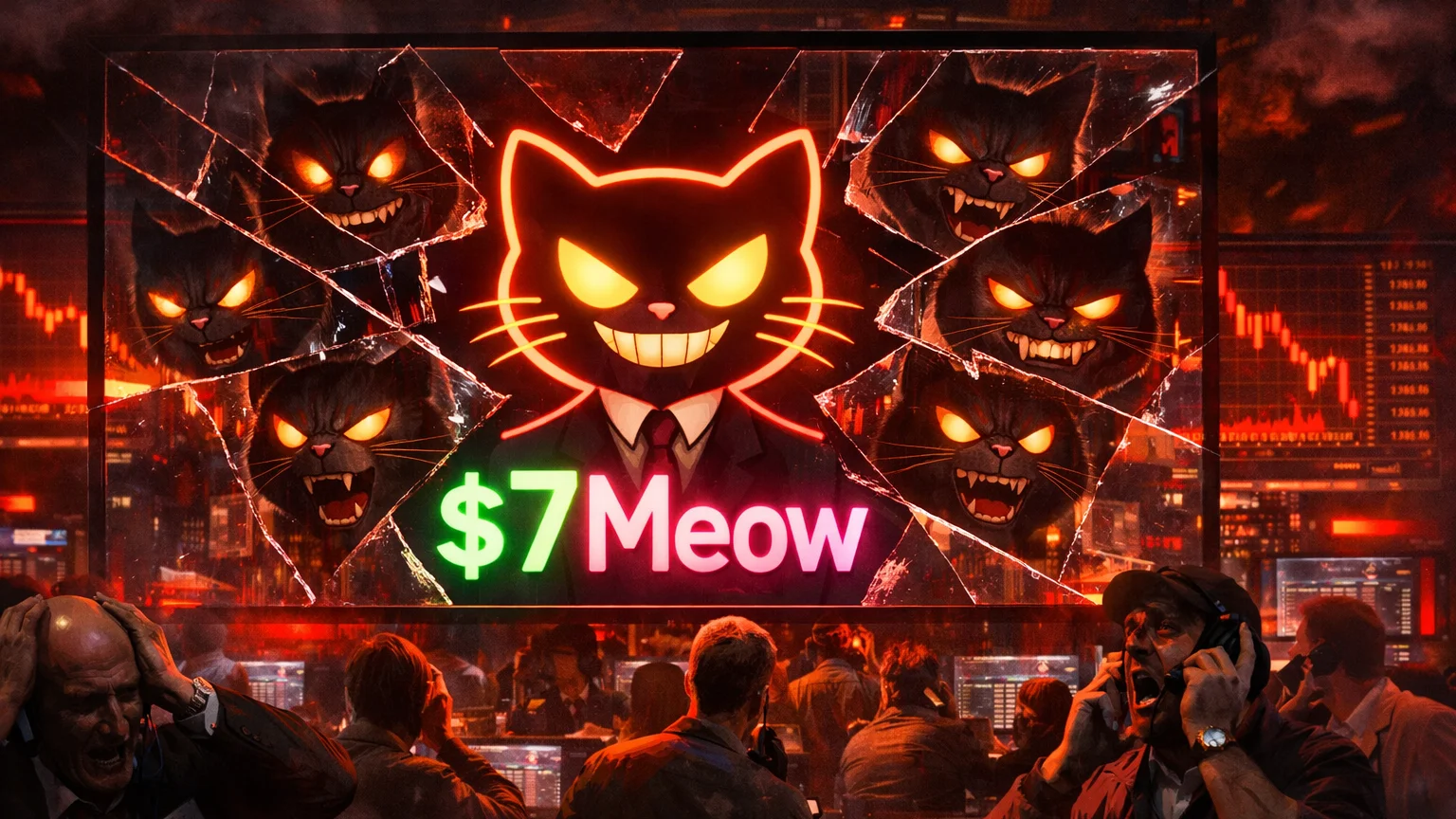
$860K in Volume, $2K in Market Cap: Inside the 7 Deadly Meow Pump-and-Dump Cycle
14,000 transactions in five hours generated almost a million dollars in volume — and left the token at a $2,000 market cap. The math doesn't lie.
Top non-LP wallet holds 21.93% of supply
At 4:36 AM UTC on March 26, a pump.fun token called 7 Deadly Meow graduated to Raydium and immediately attracted the kind of attention that makes DexScreener's trending page light up. $860,000 in trading volume. 14,199 transactions. 7,524 buys versus 6,675 sells. All within five and a half hours. And when the dust settled, the token sat at a market cap of $2,190 — down 95% from whatever fleeting high it touched on the way up.
- → $860K volume on a token now worth $2.2K — a volume-to-mcap ratio of 391:1
- → 14,199 transactions in 5.5 hours with slightly more buyers than sellers (53% buy ratio)
- → Community takeover branding with a website, X account, and Discord — but the chart tells a different story
What Makes This One Different
Nothing. That's the point. 7 Deadly Meow is a case study in the pump.fun lifecycle that plays out dozens of times daily on Solana: launch, generate volume through hype and bot activity, attract organic buyers chasing green candles, then watch the chart go vertical in the wrong direction. The 'community takeover' label — CTO in degen parlance — has become the default narrative for any pump.fun token whose original deployer has moved on. A website at 7meow.fun, a Twitter account @7meowfun, and a Discord server all materialized quickly, but none of these prevented the 95% drawdown.
The cat-themed angle isn't new either. Solana's meme token landscape is saturated with animal variants — dogs, frogs, penguins, cats. Cat memes had their moment with tokens like Popcat and MEW, but those succeeded through sustained community building and exchange listings over months, not hours. 7 Deadly Meow attempted to ride that meta in a single afternoon.
The Numbers So Far
The most telling metric here isn't the crash — it's the volume-to-market-cap ratio. At 391:1, it means that for every dollar of current token value, $391 was traded through the pair. That level of churn on a micro-cap token launched hours ago almost always indicates wash trading, MEV bot activity, or a combination of both. Real organic volume on pump.fun graduates typically settles at 5:1 to 20:1 ratios within the first day.
The buy-sell split offers a glimmer of nuance: 7,524 buys versus 6,675 sells gives a 53% buy ratio. In isolation, that looks mildly bullish — more people buying than selling. But context matters. On pump.fun tokens, buy count includes bot snipers, sandwich attacks, and arbitrage transactions that register as 'buys' but aren't human conviction. The price action — a 95% decline — tells you which side won.
Liquidity sits at $3,906. To put that in perspective: a single whale with $2,000 could move this token's price by 50%. There's effectively no floor. Any 'community' attempting a revival is pouring water into a sieve — new buys get immediately absorbed by the remaining sell pressure from early entrants looking to recoup losses.
What the On-Chain Data Shows
Rugcheck scores 7 Deadly Meow at 36 out of 100 on risk — moderate, and notably clean by pump.fun standards. No freeze authority, no mint authority, and the deployer wallet holds zero tokens. That last point sounds reassuring until you realize it's the default state for pump.fun tokens: the deployer's allocation gets sold during the bonding curve phase before Raydium graduation. A clean deployer wallet doesn't mean safety — it means the dev already extracted their value.
The top holder distribution is where it gets interesting. The largest wallet holds 88.62% of supply, which is almost certainly the Raydium AMM liquidity pool — standard for newly graduated pump.fun tokens. The second-largest non-LP wallet controls 21.93% of circulating supply. That's significant concentration risk. A single entity holding over a fifth of the tradeable supply on a $2K market cap token has effective price control. The third wallet holds 4.29%. Combined, these two non-LP wallets represent over 26% of supply — enough to crash the price to zero on a single sell order given current liquidity.
Who's In
Based on available data, the answer is: retail pump.fun speculators who arrived late and snipers who extracted early. The token's X account @7meowfun exists but has generated no verifiable traction from notable accounts. The Discord link was active at time of writing but community size couldn't be independently verified. No notable wallets or recognized CT figures have publicly positioned in 7Meow based on available on-chain and social data.
The Pump.fun Math Problem
Here's what $860K in volume actually looks like on a pump.fun token. Assume an average transaction size of $60 (generous for this micro-cap range). That's roughly 14,333 transactions — which maps almost exactly to the 14,199 recorded. Now consider that each transaction involves a buyer and a seller, and that MEV bots and arbitrageurs account for 40-60% of pump.fun transaction volume according to multiple on-chain analysts. You're left with maybe 6,000-8,000 real human transactions, split between entry and exit.
The real humans who entered during the hype phase — say at a $50K to $200K market cap — are now sitting on 97-99% losses. The ones who bought near the bonding curve graduation got out with 2-10x returns. This is the pump.fun flywheel in its most distilled form: value transfers from late retail to early snipers, with bots skimming fees along the way. The 'community takeover' narrative is the carrot that keeps late buyers holding instead of selling, extending the extraction window.
MemeDesk Verdict
🔴 Dead on Arrival — 7 Deadly Meow generated impressive-looking volume numbers that masked what was fundamentally a standard pump.fun churn cycle. $860K in volume sounds like traction until you see it sitting above $3.9K in liquidity and a $2.2K market cap. The CTO branding — website, socials, Discord — is templated infrastructure that can be deployed in under an hour. With 21.93% of supply concentrated in a single non-LP wallet and no verifiable community beyond the launch day frenzy, this is a textbook example of the Solana micro-cap lifecycle completing its full rotation in under six hours. If you're still holding, the exit is narrower than you think.
What is 7 Deadly Meow (7Meow)?
7 Deadly Meow is a cat-themed meme token launched on pump.fun and graduated to Raydium on Solana. It generated $860K in trading volume within its first hours but crashed 95% to a $2.2K market cap. The project claims to be a community takeover (CTO).
Is 7Meow a rug pull?
Not technically — there's no freeze or mint authority, and the deployer wallet is empty. However, the 95% price decline, extreme volume-to-mcap ratio, and concentrated holder distribution suggest the token followed a standard pump-and-dump pattern rather than a deliberate rug pull.
Can 7Meow recover from a 95% crash?
Recovery from this level requires a 20x just to return to pre-crash prices. With only $3.9K in liquidity and one wallet controlling 21.93% of supply, any recovery attempt would likely be met with immediate sell pressure from concentrated holders looking to exit.
What is a community takeover (CTO) in crypto?
A CTO happens when the original developer abandons a token and community members take over marketing and development. While some CTOs succeed (like Bonk's early days), the vast majority on pump.fun are used as narrative cover for tokens that have already completed their initial pump-and-dump cycle.