The $SATOSHI Ticker Doesn't Own Bitcoin — But Solana Traders Don't Care
+1,774% in 24 hours on a $641K market cap shows how brand-name tickers bypass utility entirely and trade on pure cultural association.
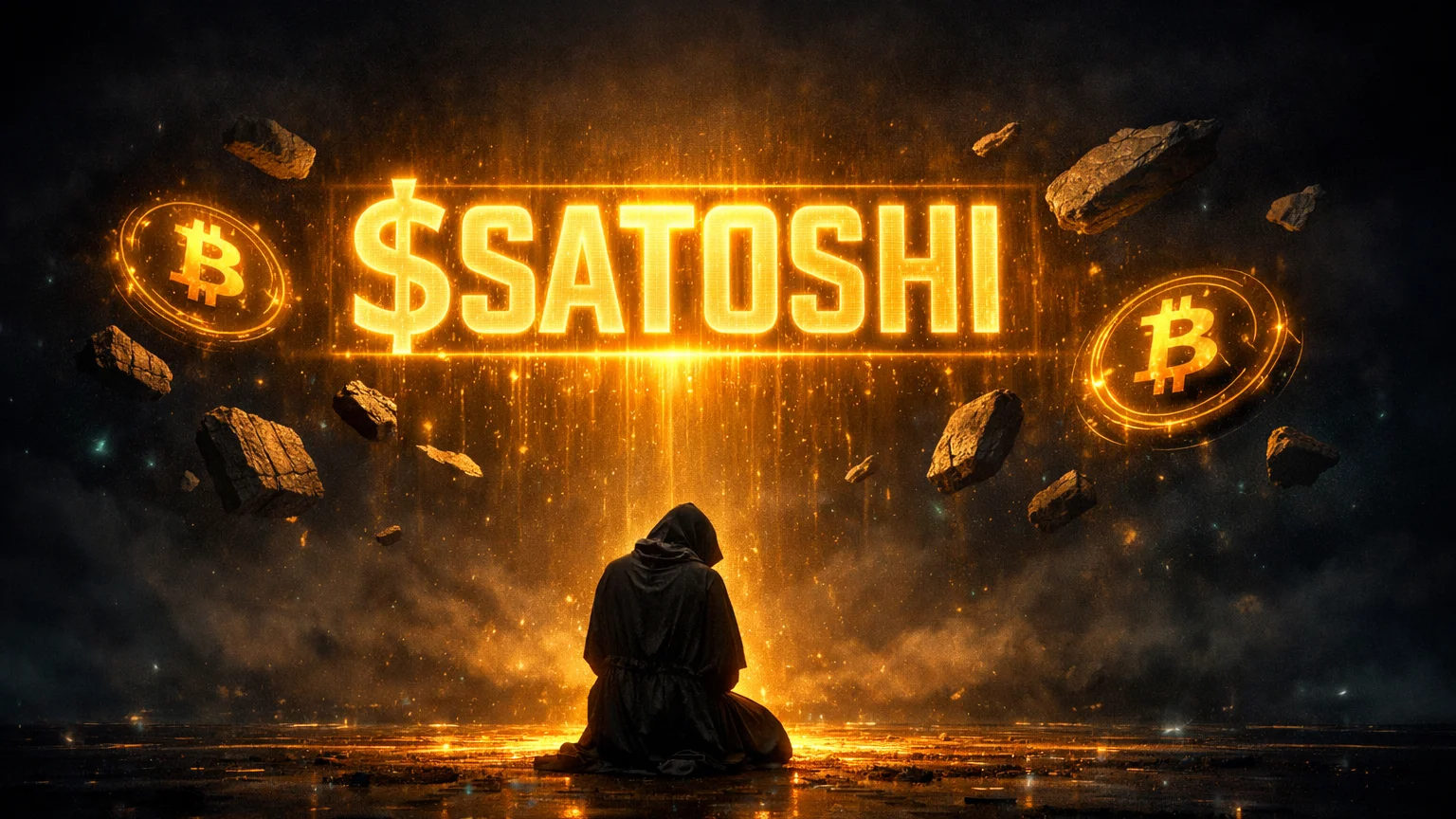
$SATOSHI is not Bitcoin. Not even close. It's a pump.fun token on Solana with no connection to Satoshi Nakamoto, no Bitcoin treasury, and no claims to the genesis of the white paper that started everything. What it has is the ticker — three syllables of cultural shorthand that every crypto participant has been conditioned to associate with monetary revolution since day one. That association, it turns out, is enough. In the last 24 hours, SATOSHI SURGE has printed +1,774% against the dollar, generating $836K in volume and arriving at a $641K market cap. The most recent hourly candle is down -2.51%, which suggests the first wave of momentum is digesting. But the move already happened — nearly 18× in one day — and the question is whether a brand this culturally freighted can find a second act.
- → $SATOSHI (SATOSHI SURGE) launched on Solana via pump.fun and posted +1,774% in 24 hours, reaching a $641K market cap on $836K in volume
- → Holder distribution is unusually clean for a pump.fun launch: top wallet at 20.69%, top 3 combined at only 28.5%, Rugcheck score 16
- → The most recent hourly candle is -2.51% — a natural first-wave cooldown that traders will be watching as the key continuation vs. exhaustion signal
What Makes This One Different
The $SATOSHI trade is pure semiotics. Satoshi Nakamoto is the most mythologized figure in all of crypto — anonymous creator, possibly dead, sitting on a trove of roughly 1.1 million Bitcoin that has never moved since the network's earliest days. The name carries the weight of the entire genesis of digital money. It represents decentralization, the mystery of creation, and a canonical origin story referenced in every serious crypto conversation. Within the community, 'Satoshi' functions less like a brand and more like a sacred text — universally positive, carrying associations of legitimacy and foundational importance that no other name in the space quite matches.
When that name appears as a pump.fun ticker, it doesn't need to do anything else. The cultural pre-loading does the work. Traders who've been conditioned to process 'Satoshi' as a high-signal word see the ticker, pattern recognition fires, and they interact before consciously evaluating whether the association is deserved. This isn't unique to $SATOSHI — the $TRUMP phenomenon on Solana ran the identical playbook, as did multiple $ELON variants across different cycles. Brand-name tickers that borrow cultural equity from figures larger than themselves have consistently shown the ability to generate outsized first-day momentum on pump.fun. The variable is always whether that borrowed momentum can compound into something self-sustaining before the cultural arbitrage closes.
The Numbers So Far
The 1.3× volume-to-market-cap ratio tells a structurally different story than a pure churn play. When 24-hour volume roughly matches the market cap, the move was directional — buyers came in steadily throughout the period and pushed price to a new equilibrium, rather than the same capital spinning through multiple fast trades. Compare this to a 6× ratio, which signals rapid rotations and day-trader activity dominating. A 1.3× ratio after a +1,774% pump means there's still underlying demand at current levels and that the token hasn't yet been exhausted by short-cycle flippers. That's a structurally different setup for the next move.
The $63.8K liquidity pool deserves a mention. For a sub-$1M pump.fun launch, this is more robust than typical. Most tokens at this market cap stage carry $20-40K in liquidity; SATOSHI SURGE's $63.8K gives the pool a roughly 10% liquidity-to-market-cap ratio, above the 5-7% more commonly seen at this size. Deeper liquidity means the token can absorb larger individual buy and sell orders without the sharp price impact that characterizes thinner pools. For traders sizing in with meaningful capital — rather than pure micro-position speculation — the deeper pool makes this more accessible than most comparable launches.
What the On-Chain Data Shows
The on-chain structure for $SATOSHI is the clearest positive signal in this article. Top holder at 20.69% — significant, but not alarming by any stretch. The second and third wallets hold 4.59% and 3.21% respectively. Combined top-three concentration of 28.5% is among the healthiest distribution profiles you'll encounter on a token that just printed nearly 18× on its launch day. High-concentration launches typically show a single wallet with 40-60% early — often a pre-seeder or insider taking advantage of bonding curve mechanics before open trading begins. That pattern is absent here.
The deployer wallet profile confirms what a clean launch looks like: a first-time wallet, zero creator balance, no freeze authority, no mint authority, no prior token launches on record. Rugcheck gives the contract a 16 out of 100 risk score — low risk — with no flagged dangers or errors in the report. There are no hidden trap doors in the contract. Dev is not holding a position, cannot freeze transfers, and has no history suggesting a coordinated serial-launch operation.
The distribution that resulted from the +1,774% first-day move appears genuinely organic. Supply is spread across enough wallets that the concentration data doesn't suggest pre-seeded insider positions. This is consistent with a token that attracted retail attention progressively throughout its launch day — a wave of buyers arriving at different entry points, creating a more balanced holder base than a coordinated launch produces. Clean contracts and distributed holdings are not sufficient reasons on their own to enter a meme trade, but they are meaningful signals that the risk profile here is lower than the typical pump.fun launch at this stage.
The Brand Ticker Playbook
Brand-name tickers have a specific lifecycle on Solana. Phase one is the name recognition spike — the initial pump driven by the ticker's cultural weight rather than any fundamental thesis about the token itself. This is where $SATOSHI sits right now. Phase two is the CT discovery window: if influential accounts start posting about the ticker, writing the 'this isn't real Satoshi but what if' narrative, or tagging large wallets into the chart, the name association gets amplified beyond initial DexScreener discovery and a second wave of buyers arrives with more capital and more momentum.
Phase three is where brand tokens diverge sharply. The ones that build a community identity around the name — sustaining the joke, creating genuine lore, finding a personality that's separate from the borrowed cultural equity — can hold value and build to progressively higher market caps over weeks. The ones that exhaust the name recognition without finding their own narrative print a top somewhere in phase two and fade as the cultural arbitrage closes and the next name-ticker captures attention.
$SATOSHI has one structural advantage in the phase-two potential that distinguishes it from divisive political tickers: the name is uniquely positive within the crypto-native audience most likely to be trading pump.fun tokens. Political brand tickers generate active adversarial trading — people who dislike the political figure short the token or refuse to participate, splitting the potential audience. Satoshi Nakamoto carries no such adversarial energy within the crypto community. The name is revered across ideological lines in the space. That one-sided cultural alignment makes phase-two amplification a more reliable mechanism here than it would be for a politically charged ticker of comparable reach.
🟡 Speculative — $SATOSHI's brand is real, its holder distribution is among the cleanest in the current pump.fun selection, and the first-day move validates the thesis that cultural equity drives capital on Solana without requiring utility or a team. The -2.51% hourly cooldown is the current pivot point. A recovery and continuation here means phase-two discovery is beginning; a continued bleed means the first wave of buyers is rotating out and the cultural arbitrage has run its course. The deeper liquidity pool and healthy distribution give this more room to absorb a second leg than most sub-$1M pump.fun launches would have — but the next move is catalyst-dependent, not structural.
What is SATOSHI SURGE ($SATOSHI)?
SATOSHI SURGE is a Solana meme token trading under the $SATOSHI ticker. It launched via pump.fun and gained +1,774% in its first 24 hours of trading, generating $836K in volume. The token has no utility and no affiliation with Satoshi Nakamoto or Bitcoin. It's a brand-association meme play designed to capitalize on the cultural weight of the 'Satoshi' name within crypto communities.
Does $SATOSHI have any connection to Satoshi Nakamoto?
None. SATOSHI SURGE is an entirely independent pump.fun meme token on Solana with no technological, organizational, or legal connection to Satoshi Nakamoto, the Bitcoin network, or any Bitcoin-adjacent project. The ticker is a deliberate brand association play — the token exists purely to capture trading activity from the cultural recognition the Satoshi name generates. Any connection between this token and Bitcoin or its creator is nominal and entirely one-sided.
Why does holder distribution matter for pump.fun tokens?
Holder concentration is one of the clearest risk signals for pump.fun launches. When a small number of wallets hold a large percentage of supply, those holders can exit into any buying pressure and collapse the price rapidly. $SATOSHI's top-three concentration of 28.5% is significantly lower than the 50-70% commonly seen in coordinated launches, meaning no single entity has enough market share to unilaterally break the chart. Clean distribution suggests organic accumulation across multiple independent buyers rather than a pre-seeded insider operation, which meaningfully reduces the coordinated-dump risk.