$490K in Volume for a Token Called Liquefied Natural Gas — Solana Degens Are Now Trading Energy Commodities as Meme Coins
A pump.fun token named after a real-world energy commodity just ripped 338% with nearly half a million in daily volume. If commodity-themed memes become the next Solana meta, $LNG is the opening trade. If this is a one-day joke, someone just paid half a million dollars to laugh at a gas pun.
No major concentration risks
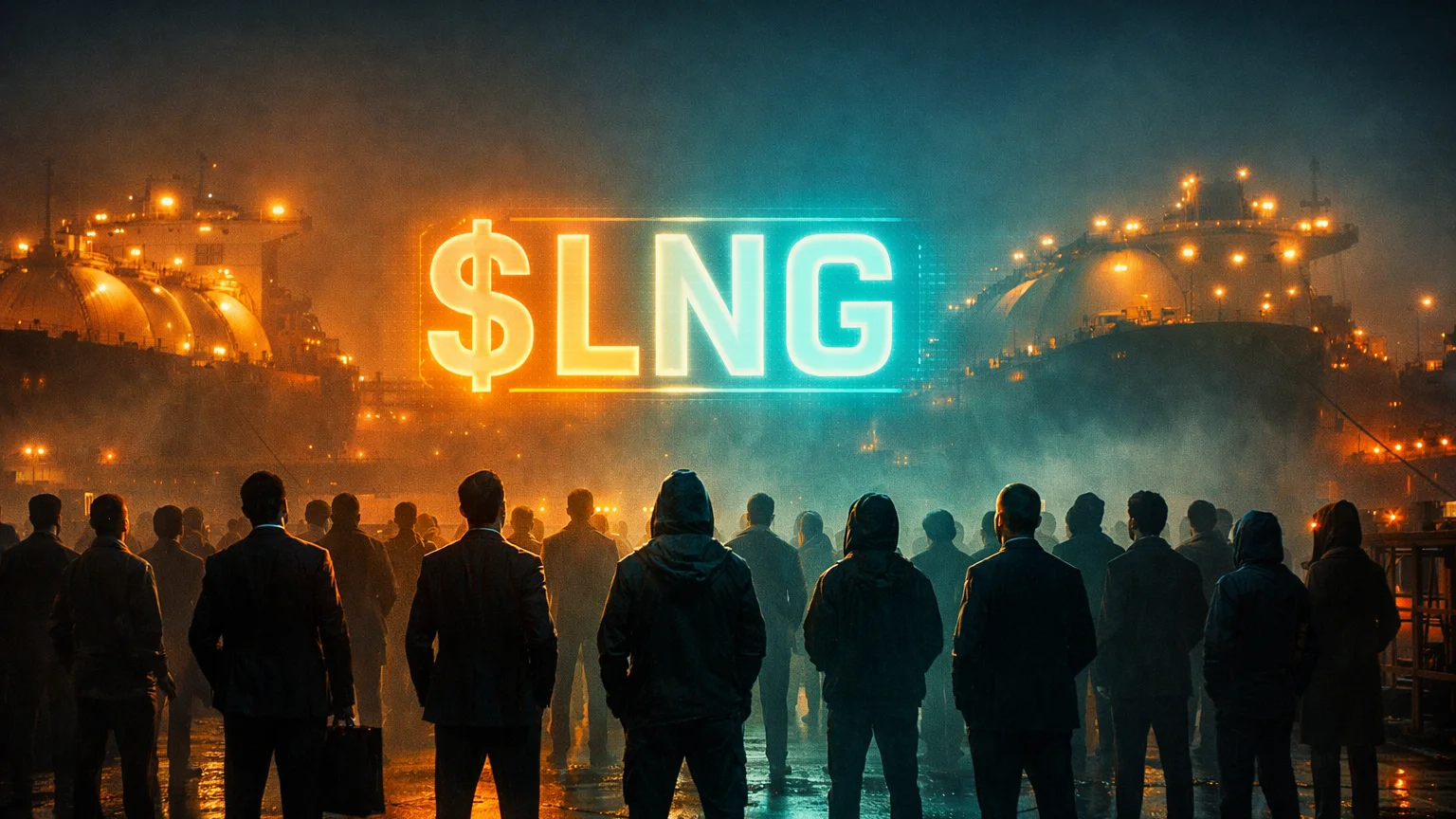
Somewhere on Solana, someone woke up and decided that the next great meme token should be named after an energy commodity. Liquefied Natural Gas — trading under $LNG — launched on pump.fun roughly 57 hours ago, ripped 338% in 24 hours, and has processed $491K in volume. That's nearly half a million dollars traded on a token whose entire identity is a gas industry acronym. The pump.fun graduate now sits at a $121K market cap with $29.2K in liquidity, an 88.8% buy ratio, and a community Telegram that actually exists. Welcome to the commodity meme meta.
- → $LNG pumped 338% in 24h on $491K volume — 4x its own market cap traded in a single day
- → Buy ratio at 88.8% with 42,222 buys vs 5,307 sells — overwhelmingly one-directional flow
- → Top wallet holds 11.54% of supply, Rugcheck score of 1, no freeze or mint authority — structurally clean but one whale concentration flag
What Makes This One Different
The meme token meta on Solana has cycled through AI agents, political tokens, celebrity coins, and animal derivatives. Each wave follows the same pattern: someone finds an untapped cultural reference point, wraps it in a pump.fun token, and the CT hivemind decides whether it's funny enough to trade. Commodity-themed tokens are the logical next step in the abstraction ladder — taking real-world financial instruments and turning them into joke assets.
$LNG is doing something specific with this template. The name isn't random — liquefied natural gas is one of the most geopolitically charged commodities in the world. LNG trade deals make front-page news. Energy prices affect every economy on Earth. And the ticker $LNG already carries weight in traditional finance, where Cheniere Energy has traded under that symbol on the NYSE for decades. Sound familiar? It's the same ticker-arbitrage playbook that drives attention to meme tokens sharing symbols with established assets.
What separates $LNG from the daily pump.fun noise is infrastructure. The token has a website (lng.totalh.net), an X community page, and a Telegram group — all set up within 57 hours of launch. Most pump.fun tokens die without ever establishing a social presence. The fact that someone bothered to build the minimum viable community architecture suggests intent beyond a quick deploy-and-dump.
The Numbers So Far
The volume-to-mcap ratio is 4.05x. Read that again. Four times the entire market cap traded in 24 hours. For reference, most established meme tokens operate at 0.1-0.5x. A ratio above 1x signals extreme speculative activity. At 4x, this isn't trading — it's a mosh pit. People are flipping in and out at a pace that makes day traders look patient.
The buy-sell ratio is the headline number: 88.8%. Out of 47,529 transactions, 42,222 were buys and only 5,307 were sells. That's an 8:1 ratio. On one hand, this shows overwhelming buyer conviction — people want in and nobody is leaving. On the other hand, a ratio this skewed often precedes a violent reversal. When 88% of your market is buyers, the eventual sell pressure — once profit-taking starts — hits a shallow liquidity pool ($29.2K) like a freight train.
The token has 6 active trading pairs on Solana, suggesting it's been picked up by multiple liquidity pools beyond the initial pump.fun deployment. Pair age at 57 hours puts it solidly in the 'survived the first two days' category — roughly 70% of pump.fun tokens die within 48 hours, so making it to day three with rising volume is a real filter.
What the On-Chain Data Shows
Rugcheck gives $LNG a score of 1 — the cleanest possible rating. No freeze authority, no mint authority, both disabled at launch. The deployer wallet holds zero tokens. No prior token launches from this wallet.
The holder distribution tells a more nuanced story. The top wallet controls 11.54% of total supply — not catastrophic, but worth watching. That single wallet represents roughly $14K in value at current prices. If that holder decides to exit, the $29.2K liquidity pool would absorb most of it, but the price impact would be severe — potentially a 30-40% drawdown depending on pool depth at the time of sale.
Below the top wallet, concentration drops sharply: 2.8% and 2.24% for the second and third largest holders. The combined top-three concentration is 16.6% — moderate for a pump.fun token this young. No insider flags on any of the top wallets. The distribution suggests that beyond the one large position, accumulation has been organic and spread across a wider base.
Who's In
The X community page (x.com/i/communities/1958946754252218853) and Telegram group (t.me/LNGcommunity) suggest organized community building. For a 57-hour-old token, having both channels active is unusual — most pump.fun tokens rely entirely on DEX chart chasers for their first week of volume.
The community angle is the bet within the bet. If $LNG is purely a chart-chase token, it dies when the chart flattens. If the community coalesces around the commodity-meme identity and starts generating content — energy jokes, gas pipeline memes, OPEC parodies — it has a shot at becoming a category anchor. The infrastructure is there. The question is whether anyone shows up to use it.
The Commodity Meme Thesis
Every meme meta on Solana follows a pattern: one token proves the concept, then a dozen clones flood the market. If $LNG represents the beginning of a commodity-themed meme wave, the playbook predicts we'll see $OIL, $COAL, $URANIUM, and $COPPER tokens within days. The first mover in a new meta typically captures the largest share of attention, even if later entries outperform on mechanics.
The timing isn't random. Energy prices are front-page news globally. LNG specifically is at the center of geopolitical tension — European energy security, Asian import competition, US export capacity. The real-world narrative gives the meme a perpetual content engine. Every time LNG appears in a Reuters headline, there's a potential CT crossover moment. That's the same dynamic that powered political meme tokens through election cycles.
The counter-thesis: commodity memes are too niche. Dog tokens work because everyone likes dogs. Political tokens work because everyone has opinions. Energy commodities? The Venn diagram of people who understand LNG pricing and people who trade Solana meme coins might be a very small circle. The meme only works if it transcends the reference — if '$LNG' becomes funny independent of whether you know what liquefied natural gas actually is.
The Bear Case
An 88.8% buy ratio is a ticking clock. That kind of one-directional flow doesn't sustain — it either stabilizes at a lower ratio as a holder base forms, or it reverses violently when the first wave of profit-takers hits. At $29.2K liquidity, the pool cannot absorb a coordinated exit. If the top wallet (11.54%) and a handful of mid-size holders sell simultaneously, the chart goes vertical in the wrong direction.
The 47,529 transactions in 24 hours on a $121K market cap token suggests significant bot activity. While the Rugcheck profile is clean, automated trading bots can simulate organic demand patterns that mask the true number of unique participants. The real holder count — distinct wallets with meaningful positions — is likely much lower than the transaction count implies.
MemeDesk Verdict
🟡 Speculative — $LNG has the two things most pump.fun tokens lack: a culturally loaded ticker and actual community infrastructure. The 338% pump on $491K volume proves there's demand for the concept. The Rugcheck score of 1, disabled authorities, and 16.6% top-three concentration are structurally sound. But the 88.8% buy ratio is a red flag for sustainability, the $29.2K liquidity pool is paper-thin, and the 11.54% top wallet is a single-point-of-failure risk. This is a narrative bet: if commodity memes become a Solana meta, $LNG is first mover with infrastructure. If it doesn't catch, this is a 57-hour-old pump.fun token that already did its best move.
FAQ
What is Liquefied Natural Gas ($LNG) crypto token?
Liquefied Natural Gas ($LNG) is a Solana-based meme token launched on pump.fun that uses the ticker and name of a real-world energy commodity. It has no connection to actual LNG production or trading. The token's appeal is the cultural crossover between energy market narratives and meme token speculation.
Is $LNG token related to Cheniere Energy (NYSE: LNG)?
No. The Solana meme token $LNG has no connection to Cheniere Energy or any real-world energy company. It shares the ticker symbol, which is a common meme token strategy for capturing search traffic and name recognition from established financial instruments.
Is $LNG crypto safe to buy?
Rugcheck gives $LNG a score of 1 (lowest risk). It has no freeze authority, no mint authority, and the deployer holds zero tokens. However, it has only $29.2K in liquidity, and the top wallet holds 11.54% of supply — meaning price can move sharply on relatively small trades. As with all micro-cap meme tokens, the risk of total loss is significant.
Why did $LNG pump 338%?
The pump was driven by the novelty of a commodity-themed meme token on Solana, combined with an overwhelmingly one-sided buy flow (88.8% buy ratio). The token appeared on DexScreener's trending feeds due to its unusual volume-to-mcap ratio (4x), which attracted additional speculative interest.
Where can I buy $LNG crypto?
LNG trades on Jupiter and Raydium on the Solana blockchain. The contract address is 2tJ2k9QMkaCFihDYTtLQHmpqAu51NJuXyXWZQn6Rpump. Always verify the contract address before trading — there may be other tokens using similar names or tickers.