22,550 Trades in 24 Hours: $CRISIS Turns Global Panic Into a 919% Degen Play
A meme token built on geopolitical anxiety just exploded from nothing to $383K market cap on $1.1M volume. If the world keeps burning, this is the trade that profits from the flames. If it doesn't — you're holding the ashes.
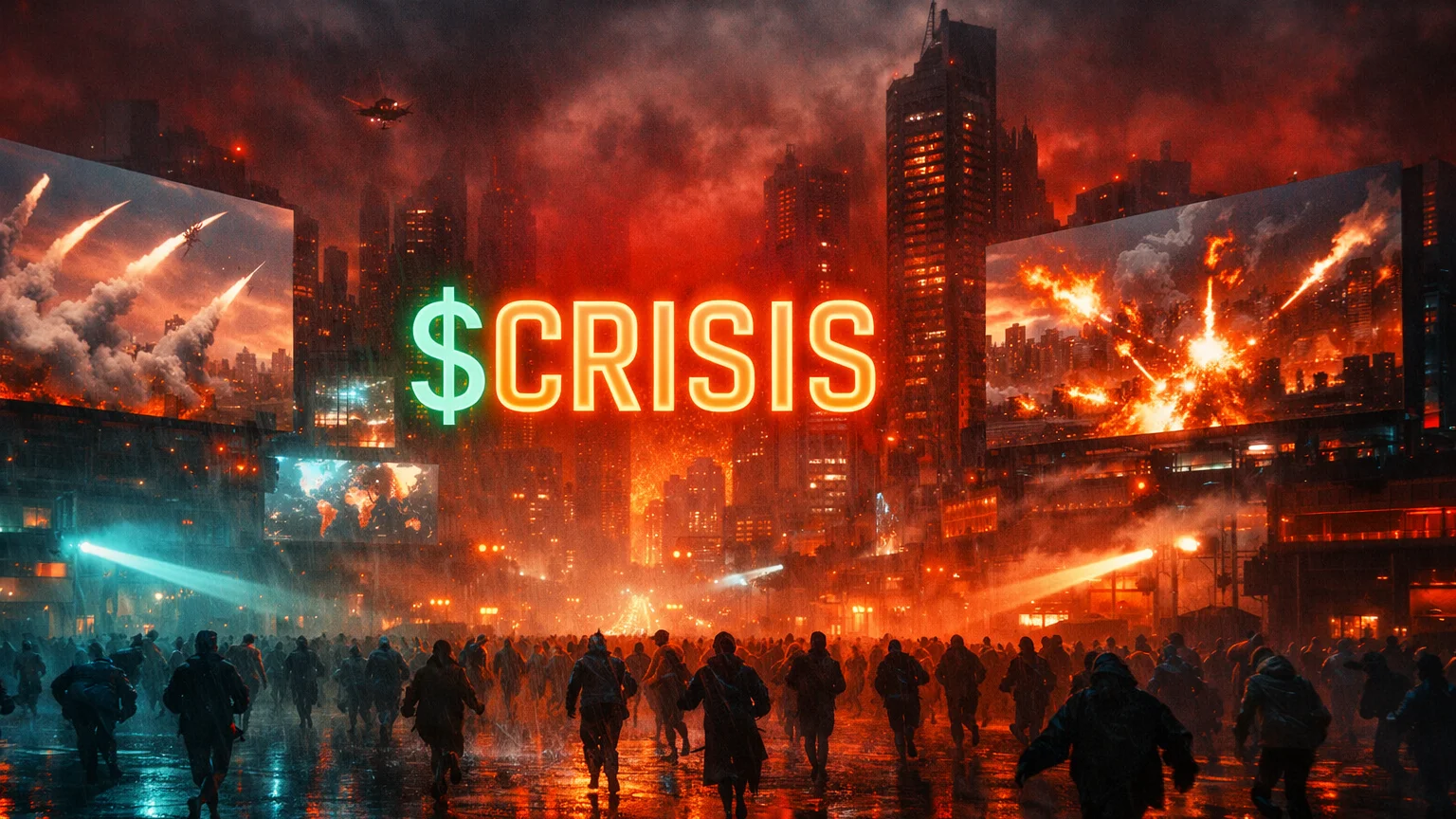
At approximately 3:00 PM UTC on March 5th, a token called World Crisis ($CRISIS) crossed $1 million in 24-hour trading volume on Solana. Not because of a KOL call. Not because of a whale accumulation event. Because the world is, by most reasonable measures, falling apart — and someone decided to make that tradeable.
US-Iran tensions escalating. Global supply chains fraying. Trade war rhetoric sharpening. The macro backdrop reads like a disaster movie screenplay, and $CRISIS has positioned itself as the meme coin equivalent of a fear/greed index — except this one actually moves with the headlines. Within 24 hours of launch, it's printed 22,550 transactions, attracted $52K in liquidity, and delivered 919% returns to early entrants.
- → $CRISIS rides the geopolitical fear narrative — every bad headline is bullish for this token
- → 919% gains, $1.1M volume, and 22,550 transactions in under 24 hours on Solana
- → Buy ratio sits at 0.66 — buyers are outpacing sellers nearly 2:1, but $383K market cap means this is micro-cap degen territory
What Makes This One Different
Narrative timing. That's it. That's the entire thesis.
Meme coins that map to real-world sentiment have a documented pattern of outperforming random token launches. WAR — a PolitiFi meme coin on Solana designed as a tradeable geopolitical sentiment index — proved this model works when global tensions rise. The SANAE token briefly hit $30M market cap off Japanese political drama before the PM disavowed it. USOR rode oil and geopolitical narratives before imploding. The playbook is established: real-world fear creates real on-chain demand.
$CRISIS isn't trying to be clever about it. The name is the narrative. The narrative is the trade. When CNN runs a chyron about missile strikes, this token pumps. When diplomats shake hands, it dumps. It's the most honest meme coin thesis available right now: the world is getting worse, and degens are betting it stays that way.
The Numbers So Far
That volume-to-market-cap ratio is absurd. $1.1M in volume against a $383K market cap means the token's entire valuation is turning over roughly three times per day. This signals extreme speculative activity — traders are cycling in and out rapidly, which creates both opportunity and danger.
The 0.66 buy ratio is the most interesting data point. Nearly two buyers for every seller suggests accumulation phase behavior, but at this market cap, it doesn't take much capital to skew that ratio. A single $10K buy would move the needle significantly.
Liquidity at $52K is paper-thin. A $5K sell order could create meaningful slippage. Anyone entering this trade needs to understand they're operating with essentially no safety net — if sentiment flips, the exit door is extremely narrow.
The Fear Trade Thesis
This isn't the first time degens have tried to monetize geopolitical anxiety. But the timing of $CRISIS is notable. US-Iran tensions have been dominating news cycles. The global trade war rhetoric between the US and China shows no signs of cooling. European energy security remains precarious. The macro environment is creating a persistent undercurrent of anxiety that mainstream markets express through VIX spikes and flight-to-safety flows — and that meme token markets now express through tokens like this.
The question is whether this anxiety has staying power. Geopolitical tokens tend to follow a distinct pattern: launch spike on headline, consolidation as traders take profit, then either a second leg driven by new catalysts or a bleed-out as attention moves on. $CRISIS is currently in the first spike phase. Whether it gets a second leg depends entirely on tomorrow's news cycle.
And that's the uncomfortable truth about fear-narrative tokens — they need bad things to keep happening. The moment tensions de-escalate, the trade thesis evaporates. You're essentially long on human suffering, which is both morally questionable and historically profitable.
Who's In
This cuts both ways. On one hand, no KOL involvement means no coordinated dump incoming from influencers who got allocated early tokens. On the other hand, without KOL amplification, the token relies entirely on the news cycle to maintain momentum. If CNN doesn't deliver a fresh crisis in the next 24 hours, this token has no secondary catalyst.
The Counter-Signal
History is unkind to fear-narrative tokens. USOR, which rode a similar geopolitical anxiety play, found no footing in reality and collapsed. WAR has proven the model can work, but it had actual product development behind it — not just a ticker symbol and a vibe. The SANAE token hit $30M on political drama, then crashed 75% when the Japanese PM said she had "absolutely no knowledge" of it.
At $383K market cap, $CRISIS is still in true micro-cap territory. The risk profile here is binary: either this catches a second wave of attention and 5-10x's from current levels, or it bleeds out over the next 48 hours as attention shifts. There is no middle ground for a token this small with this much volume.
Is This Sustainable?
Probably not. Fear-narrative tokens have a half-life measured in news cycles, not weeks. The initial 919% move has already captured the explosive phase. What remains is the question of whether $CRISIS can establish itself as a persistent fear-trade vehicle — essentially becoming the meme coin VIX — or whether it follows the typical pump.fun lifecycle: spike, dump, ghost chain.
The bull case requires escalation. Literally. Every new headline about missile strikes, sanctions, or trade wars extends the thesis. The bear case is any de-escalation, any diplomatic breakthrough, any moment where the world looks slightly less doomed. Given current geopolitical dynamics, the bull case might have legs — but trading a token that needs ongoing global conflict to survive is not a position anyone should hold with size.
🟡 Speculative — $CRISIS has the narrative timing right but everything else wrong. No team, no KOL backing, paper-thin liquidity, and a thesis that requires the world to keep deteriorating. The 919% move was the easy money. What comes next is pure coinflip territory. If you're trading this, keep size minimal and stops tight. The fear trade is real — but fear tokens die the moment hope shows up.
What is World Crisis ($CRISIS) crypto?
$CRISIS is a Solana-based meme token themed around global geopolitical tensions. It launched on pump.fun and positions itself as a tradeable proxy for world crisis sentiment. It has no team, roadmap, or utility beyond its narrative positioning.
Is $CRISIS a good investment?
At $383K market cap with $52K liquidity, $CRISIS is an extremely high-risk speculative play. The 919% initial pump has already captured the easiest gains. Any position should be treated as a lottery ticket with a high probability of going to zero.
Why is $CRISIS pumping?
The token is riding a wave of geopolitical anxiety — US-Iran tensions, global trade wars, and general macro uncertainty are creating a fear-driven narrative that meme coin traders are speculating on. Volume is high relative to market cap, suggesting rapid turnover and speculative activity.
How do geopolitical meme coins perform long-term?
History suggests poorly. Fear-narrative tokens like USOR have collapsed when the narrative lost steam. WAR has shown the model can work with actual product development, but pure narrative plays without fundamentals tend to follow a spike-and-fade pattern measured in days, not weeks.