
BARNEY Pulled $583K of Solana Volume by Pitching a One-Token War Machine
BARNEY still has the war-machine branding, a 62.3% buy ratio, and a contract profile that is cleaner than most first-day boards. If the brutal 59.13% one-hour unwind turns into real distribution, a $29.7K liquidity pool will turn military cosplay into slippage fast.
Authorities are disabled, but one wallet still controls 20.71% and the top three hold 32.1% of supply against only about $29.7K of liquidity.
By roughly 10:03 AM UTC, BARNEY had done enough to avoid the generic fresh-launch graveyard and force a real look from anyone still scanning Solana microcaps. The token was sitting near a $136,936 market cap with roughly $583,031 in 24-hour volume while the main pair was only about 5.2 hours old. DexScreener's enrichment snapshot showed 20,640 total swaps, 12,857 buys against 7,783 sells, and a 62.3% buy ratio. The daily candle was still up 271%, but the one-hour read had already cracked 59.13% lower before bouncing 21.35% over the last five minutes. That combination is exactly why BARNEY matters: the board is clearly alive, but it is already testing whether buyers are here for a campaign or just a raid.
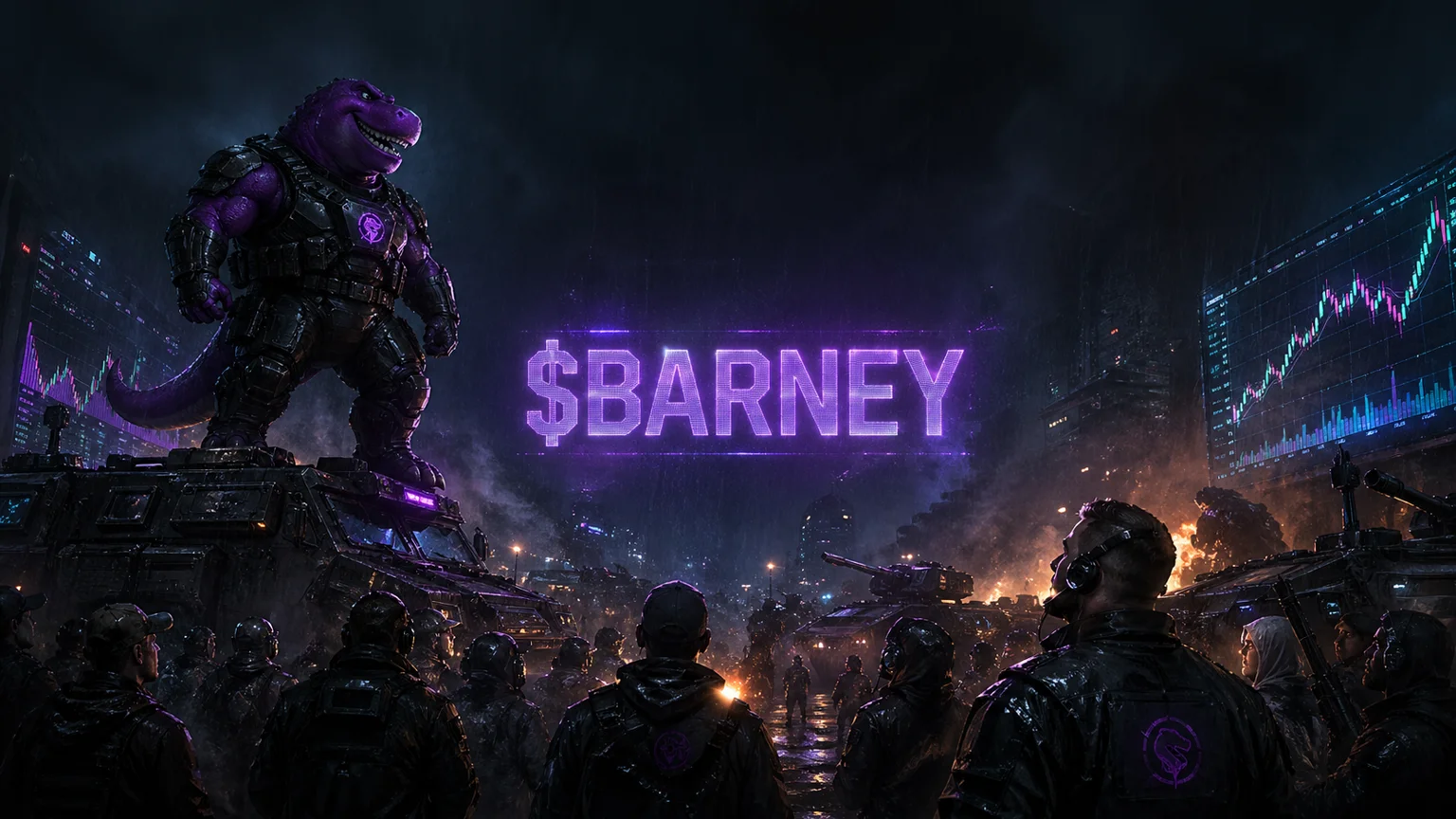
The project copy is not trying to be cute about what it is selling. The site literally opens with "ENLIST IN THE WAR MACHINE," then frames BARNEY as an extraction mission built on brute force, tactical liquidity management, zero taxes, and veteran leadership. That kind of pitch should be too cartoonish to work, yet Solana traders have always had a weakness for simple command-language branding when the tape is moving. BARNEY does not ask the market to understand lore, product utility, or deeper culture. It asks traders to imagine themselves joining a disciplined unit before the next push. In this corner of the market, that is often enough.
- → BARNEY hit launch radar with a $136.9K market cap, roughly $583.0K in 24-hour volume, and 20,640 swaps while the pair was just over five hours old.
- → Order flow still leaned bullish at 12,857 buys against 7,783 sells, but the board also ate a sharp 59.13% one-hour unwind before the latest bounce.
- → Authorities are disabled and Rugcheck sits at 42, yet one wallet owns 20.71% and the top three control 32.1% of supply against only about $29.7K of liquidity.
What Makes This One Different
Most first-day Solana launches fail because the branding is forgettable even before the chart breaks. BARNEY does not have that problem. The whole package is built around old-soldier swagger: mission brief language, extraction-point urgency, and an "old guard, new rules" posture that is easier to remember than another random mascot pretending to be destiny. That matters because early meme liquidity is not attracted by nuance. It is attracted by instant recognition. A trader scrolling fast can understand BARNEY in one glance, and tokens that compress their fantasy that cleanly usually get more than one chance to prove themselves.
The second difference is that the flow was real enough to survive the first adrenaline dump. A lot of aggressive first-hour boards post one loud candle, then disappear the moment sellers touch them. BARNEY already took that punch. The one-hour reading was down hard, yet the five-minute read was back up 21.35% by snapshot time. That does not make the bounce trustworthy on its own. It does tell you the board still had dip buyers watching closely enough to respond. In launch-radar terms, that is useful separation between a dead chart and an unstable but still tradable one.
There is also a cleaner emotional frame here than the average microcap gives you. BARNEY is not selling cuteness, irony, or outsider art. It is selling command, toughness, and the fantasy that somebody serious is finally in charge. That sounds ridiculous written out, but the market routinely monetizes that mood. When traders are exhausted by scam-meta jokes and copy-paste animal launches, a board that talks like a field commander can feel refreshing even if the structure underneath is still pure memecoin chaos. BARNEY is benefiting from that contrast.
The Numbers So Far
The strongest bullish statistic is still the simplest one: BARNEY traded more than four times its market cap in daily volume while the main pair was barely five hours old. That is not background noise. That is evidence the board kept getting recycled instead of merely discovered. The 20,640 swaps matter for the same reason. Tiny boards can fake a candle. They have a much harder time faking that many repeated interactions unless the symbol is actually capturing attention. BARNEY was not just seen. It was actively passed around.
The danger is that the same turnover that makes the board exciting also exposes how fragile it still is. Roughly $29,660 of liquidity is enough to make the chart move fast in both directions, but it is nowhere near deep enough to make exits graceful when sentiment flips. BARNEY is living in that classic first-day zone where every buy feels heroic until somebody bigger decides they are done. The steep one-hour drawdown already showed how little room there is between confidence and panic. If the flow stays hot, shallow liquidity becomes a turbocharger. If the flow stalls, it becomes the trapdoor.
The buy-sell split gives the board one more reason to stay on radar. With 12,857 buys versus 7,783 sells, the tape was not balanced around indifference. Buyers were still winning the count battle comfortably, which helps explain why the chart found a short-term response after the plunge. But this is not one-way devotion either. A 62.3% buy ratio is supportive, not bulletproof. It says BARNEY still had believers; it does not say the believers are patient. On a board like this, patience usually lasts exactly until the next candle makes somebody nervous.
What the On-Chain Data Shows
On-chain, BARNEY is cleaner than the macho branding might make you expect. Freeze authority is disabled. Mint authority is disabled. Rugcheck scored the token at 42, which is not pristine but also not the kind of number that screams obvious contract abuse. The more useful read is holder structure. The top wallet owns 20.71% of supply, the second controls 10.22%, and the third adds another 1.15%, putting the top-three cluster at 32.1%. None of those wallets are flagged as insiders in the saved profile, which matters because the risk here looks more like concentration than hidden coordination.
The deployer wallet itself is not carrying the story. The saved profile does not point to a notable retained dev bag, an active authority backdoor, or a serial-launch history worth turning into fake alpha. That is normal, and normal is fine. The actual signal sits in how a relatively acceptable contract profile is colliding with extremely thin liquidity. A top wallet at 20.71% is manageable only while that inventory stays disciplined. The moment that discipline breaks, low-liquidity warnings stop being theory and start being the whole chart. BARNEY is not screaming rug from the contract layer. It is daring traders to respect structure before structure matters.
Why This Launch Matters
BARNEY matters because it says something honest about what still works in the trenches. The market is clearly willing to reward forceful branding when it arrives with real velocity. That should not be surprising, but it is still useful to see in data. Traders are not demanding originality from every new board. They are demanding an easy emotional frame, a ticker they can repeat, and just enough order-flow proof to believe the move is bigger than one wallet cosplaying conviction. BARNEY checked those boxes fast enough to matter.
The harder question is durability. A token that already absorbed a 59.13% one-hour hit on day one is not building a calm base. It is building a reputation for violence. That can still be profitable if the board keeps attracting fresh attention and if buyers keep treating pullbacks like enlistment opportunities instead of warnings. But it also means BARNEY is one of those launches that has to keep earning its own myth every hour. If the volume remains elevated, the military theater can keep working. If the attention moves on, the war machine becomes a very small boat in rough water.
Verdict
🟡 Speculative launch-radar board with enough real flow to stay relevant and enough fragility to punish laziness. BARNEY earned the look because $583.0K in daily volume, 20,640 swaps, and a 62.3% buy ratio are not fake-nice numbers on a $136.9K board. Disabled authorities and a middling Rugcheck score keep the contract from looking immediately broken. The problem is structural: a 59.13% one-hour hit, only $29.7K of liquidity, and a 20.71% top wallet mean the chart can flip from disciplined-war-machine fantasy to pure exit scramble with very little warning.
FAQ
What is BARNEY on Solana?
BARNEY is a fresh Solana meme coin trading under contract address D6K3eYeogs6h7sW9puJkgjpv1oWKQ17bskmZB12Bpump. At selection time it was trading near a $136.9K market cap with roughly $583.0K in 24-hour volume.
Why did BARNEY make launch radar?
Because the token paired memorable military-style branding with real order flow. DexScreener showed 20,640 swaps, 12,857 buys, and a 62.3% buy ratio while the pair was just over five hours old.
Is the BARNEY contract clean?
Cleaner than many first-day boards. Mint authority and freeze authority were disabled, and the saved Rugcheck profile scored the token at 42. That helps, but it does not cancel liquidity and holder concentration risk.
What is the biggest on-chain risk for BARNEY?
The biggest structural risk is concentration meeting shallow depth. One wallet controls 20.71% of supply, the top three hold 32.1%, and liquidity was only about $29.7K at selection time.
What would confirm BARNEY still has another leg?
The cleanest confirmation would be sustained volume, continued buy-side control, and proof that the board can absorb more profit-taking without losing the current market-cap zone. If volume fades or a top wallet starts unloading aggressively, the setup weakens fast.