ANTS Swarms to +139% in 6 Hours on $947K Volume — The Micro-Cap 'Retail Army' Play That Refuses to Die
With a market cap under $100K and volume-to-mcap ratio exceeding 11:1, ANTS is either the purest community play on Solana right now or the most efficient exit liquidity trap of the week.
Six hours. That's how long it took ANTS — a Solana micro-cap trading under the banner of "Ant Investors" — to rally 139% on volume that dwarfs its entire market cap by a factor of eleven. Nearly $1 million in trades has flowed through a token worth $85,000. If that ratio doesn't make your pattern-recognition instincts fire, you haven't been paying attention to how micro-cap memes actually work.
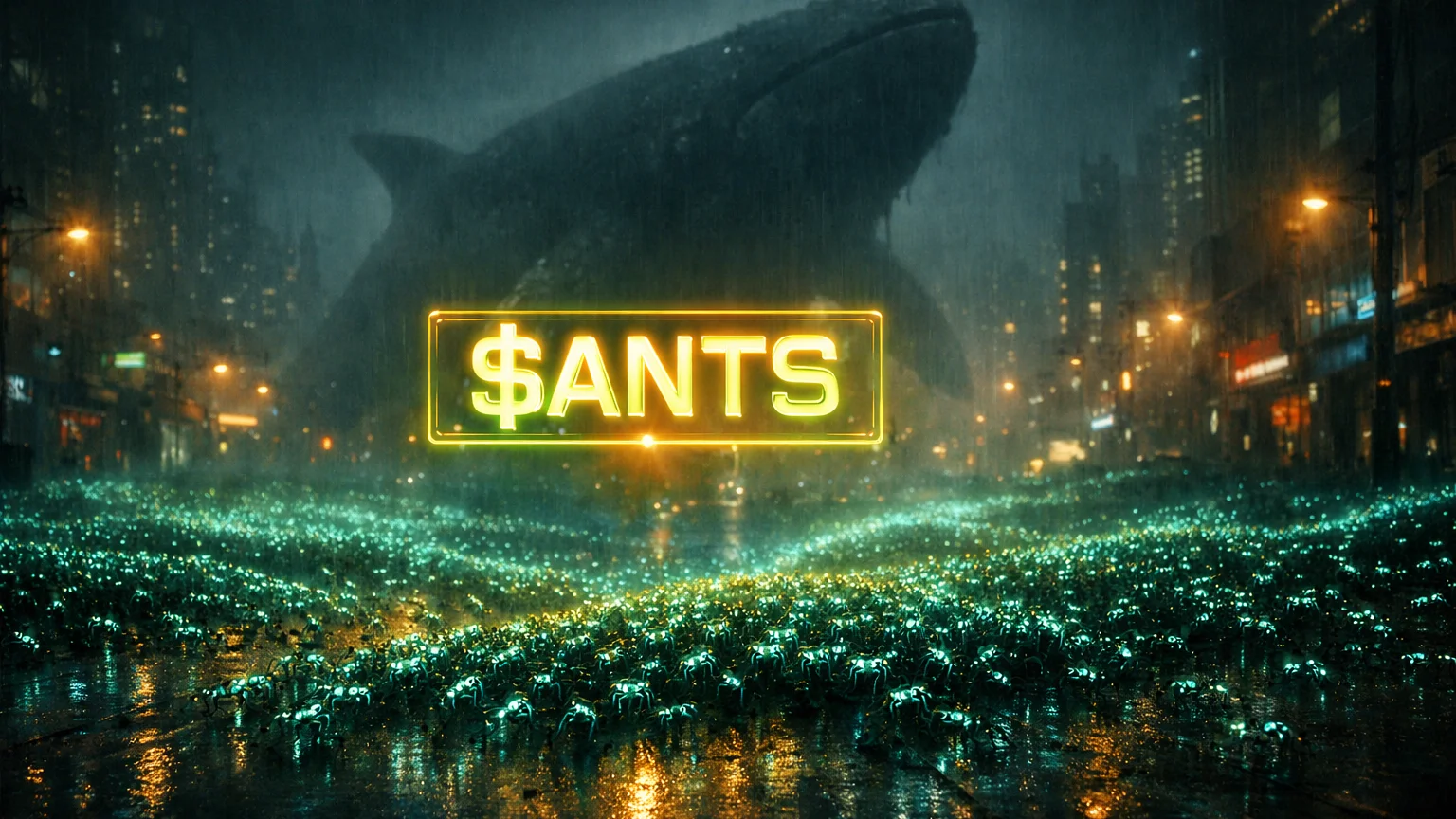
The thesis is dead simple and instantly memeable: ants versus whales. Thousands of tiny wallets swarming a token, collectively outmuscling the early deployers who typically extract value and move on. It's the populist fantasy of every degen who's ever watched a dev wallet dump at the first green candle — except this time, the swarm is winning.
- → ANTS has rallied 139% in just over 6 hours, logging $947K in volume against an $85K market cap — volume-to-mcap ratio of 11:1
- → Nearly 20,000 transactions recorded with a 55.6% buy ratio, suggesting sustained organic accumulation rather than a single whale-driven pump
- → The 'ants vs whales' narrative maps perfectly to the retail underdog trope that has powered some of the most viral micro-cap runs on Solana this cycle
The Swarm Thesis
Every cycle produces its populist meme. Last year it was anti-VC tokens. Before that, it was fair launches. The through-line is always the same: retail versus the machine. ANTS takes that narrative and makes it literal. The branding positions holders as ants — individually insignificant, collectively unstoppable. It's the kind of framing that writes its own marketing copy and generates its own memes without a team having to lift a finger.
What makes the ANTS narrative particularly sticky is how it reframes the usual micro-cap dynamic. In most sub-$100K tokens, the story is simple: a dev deploys, early snipers accumulate, a pump happens, insiders dump, retail holds bags. The ant army narrative inverts this by turning the bag-holding into a feature. You're not exit liquidity — you're a soldier in the swarm. That reframing is powerful because it gives holders a reason to hold through the first dip instead of panic-selling, which is precisely how micro-caps build momentum past their initial pump.
The Numbers Behind the Noise
Start with the volume-to-market-cap ratio: 11.1x. For context, most established meme tokens consider a 1:1 ratio a high-activity day. An 11:1 ratio means the token's entire market cap has turned over eleven times in six hours. That level of churn can mean one of two things: genuine discovery-phase accumulation where new buyers keep rotating in, or sophisticated wash trading designed to manufacture the appearance of interest. The buy ratio of 55.6% leans toward the former — it's elevated enough to show net accumulation but not so lopsided that it screams manipulation.
The transaction count is the more telling data point. Nearly 20,000 transactions in six hours across a token with $24K in liquidity means the average transaction size is roughly $47. That's not whale activity. That's hundreds or thousands of small wallets aping in with lunch money — which is exactly the pattern you'd expect from a token whose entire brand is built around small participants acting collectively. The data, at least on the surface, matches the narrative.
Why Community Narratives Hit Different at Micro-Cap
There's a mechanical reason why the 'retail army' narrative works better at $85K market cap than it would at $85M. At micro-cap, the collective action problem is actually solvable. You don't need a million coordinated buyers — you need a few hundred degens in a Telegram group who each throw in $50-$200. The math is simple: 500 wallets averaging $170 each equals the entire market cap. A coordinated community of a few thousand people can genuinely move the needle, which makes the narrative self-reinforcing in a way that doesn't work at larger scales.
This is also what makes micro-cap community plays dangerous. The same dynamics that enable a 139% rally in six hours work in reverse. When the swarm decides to exit, $24K in liquidity evaporates in minutes. The ant army narrative holds precisely as long as the ants keep marching forward. The moment momentum stalls, every ant becomes an individual making an individual decision — and the collective dissolves faster than it formed.
The Liquidity Problem Nobody Wants to Talk About
Let's be direct about the elephant in the room: $24,315 in liquidity. That's the total depth available to anyone trying to exit a position in ANTS. The entire liquidity pool is roughly the price of a used Honda Civic. When nearly $1M in volume trades against $24K in liquidity, it means the price impact on any meaningful sell is catastrophic. A $5,000 sell would move the price significantly. A $10,000 sell could crater it.
This creates the classic micro-cap paradox: the token is simultaneously the most exciting thing on your DexScreener trending page and completely untradeable for anyone with a position larger than a few hundred dollars. The 139% gain is real in the sense that the last trade happened at that level. Whether any meaningful number of holders can actually realize that gain is an entirely different question.
Historical Parallels: When Swarms Worked (and When They Didn't)
The retail army narrative has precedent on both sides. The original WallStreetBets GameStop saga proved that coordinated retail action could genuinely overwhelm institutional positioning — but that was in regulated equity markets with actual short squeeze mechanics. In meme tokens, the closest parallels are tokens like BONK's early days, where grassroots community distribution created genuine holder breadth that sustained price through multiple cycles. The key differentiator in the cases that worked long-term was always holder count and distribution, not volume.
The cases that failed share a common pattern: explosive initial volume driven by narrative excitement, followed by rapid liquidity extraction once the story stops being novel. The question for ANTS isn't whether the swarm can push the price up — they clearly can, and already have. The question is whether the narrative has enough staying power to attract new participants after the initial discovery phase, or whether today's 139% rally represents the peak of attention.
The Bear Case
Strip away the narrative and the numbers tell a more cautious story. An $85K market cap token with $24K liquidity that's existed for six hours is, statistically, far more likely to be a zero within 48 hours than a survivor. The Solana memecoin graveyard is full of tokens that had explosive first-day volume and compelling narratives. The survival rate for sub-$100K Solana meme tokens past the one-week mark is in single-digit percentages. The ants-versus-whales framing is compelling, but compelling narratives don't override liquidity mechanics.
There's also the question of who the whales actually are in this scenario. The token's deployer and early wallets didn't disappear because the community adopted an ant metaphor. If top wallets control meaningful supply — and at $85K market cap, even modest early positions represent significant concentration — then the swarm narrative may be providing exit liquidity to the very whales it claims to be fighting.
The Bull Case
The counter-argument is equally straightforward: every token that eventually hit $1M, $10M, or $100M market cap once looked exactly like this. Broad distribution across many small wallets is genuinely the most bullish structural signal a micro-cap can have. If the holder count is real and growing, if the Telegram is active and generating organic meme content, and if the narrative has legs beyond today's initial pump, then ANTS at $85K could look cheap in retrospect. The 55.6% buy ratio and 20,000 transaction count suggest real retail interest, not a single whale playing games. narrative strength rating of 8/10 reflects how naturally the ant army concept maps to visual content and viral sharing — the kind of organic marketing machine that money can't buy.
🟡 Speculative — ANTS has the narrative energy and the volume numbers to back up the hype, but $24K in liquidity against an $85K market cap on a token that's existed for six hours is the definition of early-stage risk. The community swarm thesis is compelling and the retail-sized transaction pattern is genuinely interesting, but zero KOL backing and catastrophically thin liquidity make this a pure conviction play. If you're in, you're betting on the swarm holding formation through the inevitable first correction. History says most swarms don't.
What is ANTS (Ant Investors)?
ANTS is a Solana-based meme token built around the 'ants vs whales' narrative — positioning retail traders as a collective swarm that can outpower large wallet holders through coordinated small-scale participation. It launched on Solana and gained attention after a 139% rally in its first six hours of trading.
Why is ANTS volume so much higher than its market cap?
ANTS recorded $947K in 24-hour volume against an $85K market cap, creating an 11:1 volume-to-mcap ratio. This is common in early-stage micro-cap discovery phases where the token is attracting rapid inflows of new participants. The nearly 20,000 transactions suggest broad retail participation rather than a few large trades.
Is ANTS safe to trade?
ANTS carries extreme risk. With only $24K in liquidity, any significant sell order will cause dramatic price impact. The token has existed for roughly six hours and has zero established track record. The sub-$100K market cap means a single actor with modest capital could dominate price action. This is a high-risk, high-reward micro-cap — position sizing should reflect that reality.
What does the ants vs whales narrative mean for meme tokens?
The ants vs whales narrative frames retail traders as a collective force that can overcome large holders through sheer numbers. In meme token markets, this narrative works because community sentiment and holder distribution genuinely influence price action more than fundamentals. However, the narrative's power depends on continued community engagement — when attention fades, the collective dissolves.